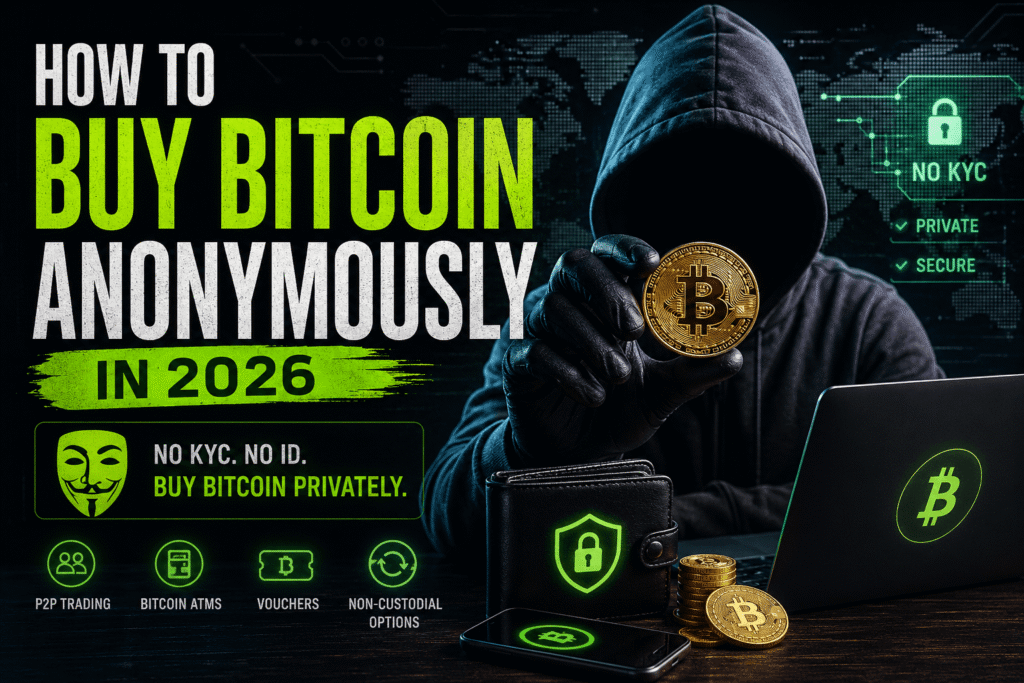

If you are looking for how to buy Bitcoin anonymously, buy Bitcoin without ID, or find a no-KYC Bitcoin option in 2026, there are still privacy-focused ways to acquire BTC without giving every platform your full identity.
However, there is an important distinction between buying Bitcoin privately and being completely anonymous.
Bitcoin itself is not an anonymous payment network. Transactions are permanently recorded on its public blockchain, and activity can potentially be connected to real-world identities through exchanges, payment methods, reused addresses and blockchain analysis. Bitcoin.org itself describes Bitcoin as pseudonymous rather than anonymous. (Bitcoin)

That does not mean privacy is impossible. It means the realistic goal is to reduce unnecessary identity exposure while understanding the limitations and rules that apply in your country.
This guide explains the main ways people look for private Bitcoin purchases in 2026, how the different methods compare, and what to consider before using any service.
Can You Buy Bitcoin Anonymously in 2026?
Must check: What Are Bank Logs Meaning – Dark Web
Yes, Bitcoin can sometimes be acquired with considerably less identity information than is required by a traditional regulated exchange.
But completely anonymous Bitcoin is difficult to guarantee.
A conventional exchange may connect your name, identification documents, payment information and Bitcoin purchases to your account. Other methods can reduce the amount of personal information collected, but the transaction itself can still leave a public blockchain record.
Current privacy-focused guides commonly discuss peer-to-peer marketplaces, Bitcoin ATMs, vouchers and certain non-custodial or no-KYC services as possible alternatives to traditional exchange accounts. Availability, limits and verification requirements vary significantly by jurisdiction and provider. (Wallet Pilot)
So when people search for “Bitcoin without ID”, what they usually mean is one of three things:
- Buying BTC without submitting government identification
- Minimizing the amount of personal information given to a provider
- Separating a Bitcoin purchase from a conventional exchange identity
Those are different privacy goals.
Anonymous vs Private vs No-KYC Bitcoin
These terms are often used interchangeably, but they are not the same.
Anonymous Bitcoin
Anonymous implies that nobody can connect the transaction to you.
That is a much stronger claim and is difficult to guarantee because Bitcoin transactions are publicly recorded.
Private Bitcoin
Privacy means reducing unnecessary exposure of your personal information and limiting how easily your financial activity can be connected to your identity.
This is generally the more realistic goal.
No-KYC Bitcoin
“No KYC” generally means a particular service does not require its standard identity-verification process for a particular transaction or account.
It does not necessarily mean:
- The transaction cannot be traced
- The service collects no information
- There are no limits
- The service works in every country
- The service will never request verification
- You have no legal or tax obligations
Some platforms can introduce verification requirements based on transaction size, payment method, jurisdiction or risk controls.
The Main Ways to Buy Bitcoin Privately
There is no single best method for everyone. The major categories in 2026 include:
- Peer-to-peer Bitcoin marketplaces
- Bitcoin ATMs where permitted
- Bitcoin vouchers or prepaid methods
- Non-custodial crypto services
- Buying BTC from an existing crypto balance
- Self-custody after purchasing
Each has different privacy, cost, liquidity and security characteristics.
1. Peer-to-Peer Bitcoin
Peer-to-peer, or P2P, Bitcoin trading allows buyers and sellers to interact directly rather than purchasing BTC from a traditional centralized exchange.
Some privacy-focused P2P systems use escrow or multisignature mechanisms to reduce counterparty risk.
Current 2026 guides identify services such as Bisq, Hodl Hodl, Peach and RoboSats among the P2P options discussed for users seeking reduced identity exposure. (Wallet Pilot)
The exact requirements differ between platforms.
Advantages
- Can reduce dependence on centralized exchanges
- Multiple payment methods may be available
- Some platforms are designed around non-custodial trading
- Can provide more privacy than a conventional fully verified exchange
Disadvantages
- Liquidity may be lower
- Prices can include a privacy premium
- Counterparty risk varies
- Payment disputes can occur
- Local availability differs
- Some services may restrict particular countries
For beginners, the most important consideration is counterparty and escrow security, not simply whether a service says “no KYC.”
2. Bitcoin ATMs
Bitcoin ATMs are another method people associate with buying BTC without ID.
Depending on the operator and local regulations, some machines may allow small transactions with limited verification. However, this is becoming increasingly dependent on jurisdiction and transaction size.
Some current guides note that ATM verification requirements have become stricter and that fees can be substantially higher than conventional exchanges. (Webopedia)
Before using an ATM, check:
- Whether the operator requires identification
- The transaction limit
- The total fee
- The exchange rate
- Whether a phone number is required
- Whether the machine supports sending BTC directly to your wallet
Never assume that an ATM is automatically anonymous simply because it accepts cash.
3. Bitcoin Vouchers and Prepaid Options
Another privacy-oriented category is prepaid Bitcoin.
The basic concept is simple: a user purchases a voucher or prepaid product and redeems it for Bitcoin.
Availability varies considerably by country, and some providers impose verification requirements at certain thresholds.
The main attraction is that the purchasing process can involve less personal information than opening a conventional exchange account.
The downside is cost.
Privacy-focused purchasing methods can carry higher spreads, fees or limits than major exchanges.
Always calculate the total BTC received, rather than looking only at the advertised transaction fee.
4. Non-Custodial Services
Non-custodial services are designed so that users retain control of their funds rather than depositing them into a conventional exchange account.
Some services support cryptocurrency swaps without requiring a traditional exchange account.
This can be useful if you already hold another cryptocurrency and want to exchange it for Bitcoin.
However, “non-custodial” and “anonymous” are not synonyms.
A transaction can still leave a public blockchain trail, and the assets used for the swap may already have an identifiable history.
Bitcoin.org explains that Bitcoin transactions are publicly recorded and that privacy depends partly on preventing addresses from being connected to real-world identities. (Bitcoin)
5. Buying Bitcoin With an Existing Crypto Balance
If you already own cryptocurrency, another approach is exchanging one cryptocurrency for BTC rather than purchasing BTC directly with fiat through a traditional exchange.
This can reduce the amount of new personal information given to the service, depending on the platform and transaction.
But it does not erase the history of the coins involved.
Blockchain transactions are permanent, and blockchain-analysis techniques can sometimes connect transactions together.
Therefore, users should not interpret a crypto-to-crypto swap as a guarantee of anonymity.
6. Self-Custody and Bitcoin Privacy
Buying Bitcoin privately is only one part of the privacy equation.
Where you store BTC matters too.
A self-custody wallet gives you control of your private keys rather than leaving your funds entirely under an exchange’s control. Bitcoin.org notes that self-custody also comes with responsibility: if you permanently lose your recovery information, there may be no third party capable of recovering the funds. (Bitcoin)
For anyone using self-custody:
- Back up your recovery phrase securely
- Never share your seed phrase
- Avoid photographing or uploading recovery information
- Keep wallet software updated
- Verify receiving addresses before sending funds
- Consider a hardware wallet for substantial holdings
Privacy should never come at the expense of basic wallet security.
No-KYC Bitcoin: What Does It Actually Mean?
A common misconception is that “no KYC” means a platform can never ask for identification.
That’s not necessarily true.
A service may allow certain transactions without identity verification while applying additional checks in other circumstances.
Requirements can change because of:
- Local regulations
- Transaction size
- Payment method
- Risk controls
- Sanctions screening
- Fraud prevention
- Changes to the provider’s policies
For this reason, don’t rely on an old list of “anonymous Bitcoin exchanges.”
A service that allowed a particular purchase without ID last year may have different requirements today.
How Private Is Each Method?
There is no universal anonymity score because privacy depends on the complete transaction path.
| Method | Potential privacy | Main consideration |
|---|---|---|
| Traditional KYC exchange | Low | Identity directly connected to account |
| P2P marketplace | Higher | Counterparty, payment method and platform requirements |
| Bitcoin ATM | Varies | Operator and local verification limits |
| Voucher | Varies | Provider rules and purchase records |
| Non-custodial swap | Higher in some circumstances | Blockchain history remains public |
| Self-custody wallet | Stronger control | Does not make blockchain activity anonymous |
These categories should be treated as general guidance rather than guarantees.
Why Bitcoin Is Not Completely Anonymous
This is one of the most important sections for anyone searching for how to buy Bitcoin anonymously.
Bitcoin addresses do not normally contain your name.
But the blockchain records:
- Sending addresses
- Receiving addresses
- Transaction amounts
- Transaction times
- Transaction history
If an address becomes connected to your identity, transactions associated with that address can potentially be analyzed.
Bitcoin.org specifically warns that Bitcoin transactions are publicly recorded and that pseudonymous privacy depends on whether an address can be connected to a real person. (Bitcoin)
That’s why private does not mean invisible.
What Can Destroy Bitcoin Privacy?
Even when someone starts with a relatively private purchase, later actions can reveal information.
Examples include:
Reusing addresses
Repeatedly using the same address can make it easier to connect transactions.
Sending funds to a KYC exchange
If privately acquired BTC is later deposited into a fully verified exchange account, that exchange can associate the deposit with the account.
Using identifiable payment information
A bank account, card or other payment method connected to your identity can create an additional link.
Publicly sharing wallet addresses
Posting an address on social media or a public website can associate it with a person or organization.
Poor wallet security
Privacy is irrelevant if your wallet credentials are compromised.
Is Buying Bitcoin Without ID Legal?
This depends on where you live and which service you use.
KYC and cryptocurrency rules differ between countries, and providers can impose requirements that are stricter than the minimum legal requirement.
Buying Bitcoin privately should not be confused with attempting to evade taxes, sanctions, court orders, anti-money-laundering requirements or other applicable laws.
If a platform requires verification for your transaction, do not assume that finding another route automatically makes the transaction lawful.
Check the rules applicable to your country before purchasing.
What Is the Best Way to Buy Bitcoin Privately?
There isn’t one answer.
The right option depends on what you’re trying to achieve.
If privacy is your main concern
Research a reputable P2P or non-custodial option available in your jurisdiction and understand its escrow, fees and verification policies.
If convenience matters most
A regulated exchange with strong security and transparent fees may be the better choice.
If you want self-custody
Use a wallet where you control the private keys and maintain a secure backup.
If you want to minimize personal information
Compare the information each provider actually requires rather than trusting a “100% anonymous” marketing claim.
How to Choose a No-KYC Bitcoin Service
Before using any platform, ask these questions:
Does it require an account?
Some services operate without traditional accounts, while others require registration.
Does it require identification?
Check the current requirements rather than relying on an old article.
What are the limits?
A service might support small purchases without verification but require additional checks for larger amounts.
What are the total fees?
Look at spreads, network fees, platform fees and payment fees together.
Is there escrow?
For P2P purchases, escrow or multisignature protection can reduce certain counterparty risks.
Does it operate in your country?
Availability and legal requirements can vary dramatically between jurisdictions.
Who controls the funds?
Understand whether the service is custodial or non-custodial.
Red Flags to Avoid
Searching for “Bitcoin without ID” can expose you to scams because criminals know that privacy-focused buyers may be reluctant to report problems.
Be especially careful with websites that promise:
- Guaranteed 100% anonymity
- Unlimited Bitcoin without verification
- Impossible-to-trace transactions
- Extremely cheap BTC
- “Instant” transactions with no explanation
- Requests to send funds directly to an unknown individual
- Fake escrow services
- Pressure to complete a transaction immediately
A privacy-focused service should still provide enough information for you to understand what you are actually using.
Don’t Confuse Privacy With Security
This is another important distinction.
A service can provide greater privacy while being less secure.
For example, buying Bitcoin directly from an unknown person might involve less identity disclosure than opening a verified exchange account, but the counterparty risk could be considerably higher.
A good decision therefore considers at least four factors:
Privacy + Security + Cost + Legality
Ignoring one of those factors can turn a privacy-focused purchase into a bad transaction.
Frequently Asked Questions
Can I buy Bitcoin without ID in 2026?
In some circumstances, yes. Certain P2P marketplaces, Bitcoin ATMs, vouchers and other services may permit purchases with limited or no traditional identity verification. Requirements vary by provider, transaction size and jurisdiction. (Wallet Pilot)
Is Bitcoin anonymous?
No. Bitcoin is better described as pseudonymous. Transactions are publicly recorded on the blockchain, and addresses can potentially be linked to real-world identities. (Bitcoin)
What does no-KYC Bitcoin mean?
It generally refers to a purchase or service that does not require the provider’s normal identity-verification process. It does not mean the transaction is untraceable or that no information is collected.
Can Bitcoin transactions be traced?
Yes. Bitcoin transactions are publicly recorded. Whether a transaction can be connected to a specific person depends on the information available to whoever is analyzing the activity.
Is buying Bitcoin privately illegal?
Not necessarily. The legality depends on your country, the transaction and applicable regulations. Privacy itself is not the same thing as attempting to evade legal obligations.
What is the most private way to buy Bitcoin?
There is no universal answer. P2P, cash-based methods, vouchers and certain non-custodial services can provide different levels of privacy, but none should automatically be treated as completely anonymous.
Does a self-custody wallet make Bitcoin anonymous?
No. A self-custody wallet gives you control over your private keys, but Bitcoin transactions remain publicly recorded. (Bitcoin)
Can I buy Bitcoin without verification and then use it normally?
That depends on the services you subsequently use. Sending BTC to a regulated exchange, payment provider or other service may trigger identification or compliance requirements.
Final Thoughts
The idea of anonymous Bitcoin is often presented as if there is a single secret method that makes BTC completely untraceable.
Reality is more complicated.
In 2026, privacy-conscious buyers can still investigate P2P markets, Bitcoin ATMs, vouchers, non-custodial services and other alternatives to conventional KYC exchanges. But every method comes with trade-offs involving privacy, fees, security, liquidity and regulation. (Wallet Pilot)
The smarter approach is therefore not to search for a magical “100% anonymous Bitcoin” service.
Instead, understand exactly what information a service collects, how the transaction works, what limits apply, how your BTC is stored, and what laws apply where you live.
Bitcoin can provide meaningful financial privacy, but privacy requires understanding how the technology works rather than simply choosing a platform advertised as “no KYC.”
If you’re looking for Bitcoin without ID, think privacy—not invisibility.