
If you looked for non VBV BINs vs non MSC BINs, or a BIN checker, you’ve probably noticed that these terms are used differently across payment and cybersecurity websites.
The problem is that much of the information online mixes official payment terminology with informal terminology used by third-party BIN databases and forums.
In 2026, understanding the difference is particularly important because online card authentication has evolved significantly. Modern payment systems use technologies such as 3D Secure (3DS), risk-based authentication, issuer verification, and fraud detection rather than relying on a simple VBV or non vBV distinction.

This guide explains what the terms mean, how BIN checkers work, where 3D Secure fits into the picture, and why static BIN classifications should be treated carefully.
What Is a BIN?
BIN stands for Bank Identification Number.
A BIN identifies a payment-card issuer or card range. Modern payment systems increasingly use eight-digit BINs, although six-digit BINs remain part of the existing payment ecosystem.
BIN information can be used to identify attributes such as:
- Card network
- Issuing institution
- Country
- Funding type
- Card type
- Product
- Account range
BIN data has legitimate uses in payment processing, fraud prevention, transaction analysis, and payment routing.
What Does Non VBV Mean?
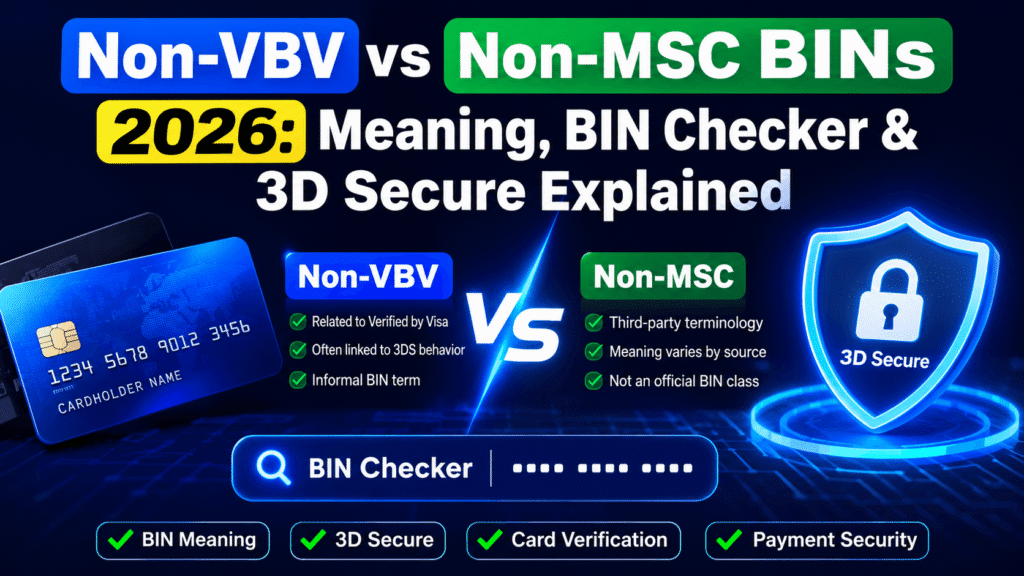
Non VBV is informal terminology commonly used online to describe a card or BIN that is believed not to trigger a particular Verified by Visa authentication flow.
VBV originally meant Verified by Visa.
Visa’s modern terminology is Visa Secure, while the broader authentication standard is known as 3D Secure.
Importantly, “non VBV” isn’t an official BIN category maintained by Visa or Mastercard.
A third-party website may label a BIN “non-VBV,” but that label doesn’t guarantee how a future transaction will be authenticated.
What Does Non MSC Mean?
Non-MSC is another term that appears in third-party BIN discussions.
Unlike established terms such as BIN, IIN, and 3D Secure, “non-MSC” isn’t a universally standardized payment-card classification.
Different websites may use the term differently.
That’s why it’s important to check what a particular BIN database means by MSC before treating a “non-MSC” label as meaningful payment information.
In other words, a BIN being described online as “non MSC” doesn’t automatically tell you whether it will be accepted by a particular merchant or payment processor.
Non-VBV vs Non-MSC: What’s the Difference?
The simplest distinction is:
| Term | General meaning |
|---|---|
| BIN | Identifies a card issuer or card range |
| Non-VBV | Informal term related to Verified by Visa/3DS authentication |
| Non-MSC | Informal/ambiguous third-party terminology |
| 3DS | Online cardholder authentication framework |
| BIN checker | Tool that returns information associated with a BIN |
The two terms shouldn’t be treated as interchangeable.
Non VBV has a recognizable historical connection to Visa authentication.
Non-MSC, on the other hand, can be ambiguous because different websites may define the acronym differently.
Does a Non VBV BIN Mean No 3D Secure?
No.
This is one of the biggest misconceptions surrounding non-VBV BINs.
Modern 3D Secure doesn’t necessarily result in an obvious OTP screen.
Depending on the transaction, authentication can involve:
- A verification code
- Banking-app approval
- Biometrics
- Device authentication
- Risk-based authentication
- A challenge presented by the issuer
Therefore:
No visible OTP challenge does not necessarily mean no authentication.
A payment can be assessed using multiple risk signals before the issuer decides whether an additional customer challenge is necessary.
What Is 3D Secure?
3D Secure, commonly abbreviated as 3DS, is an authentication framework designed to help secure online card payments.
Visa uses the Visa Secure branding, while Mastercard has its own implementation.
The goal is to help establish that the person making an online payment is authorized to use the card.
Modern 3DS versions can provide a relatively frictionless experience when the transaction is considered low risk.
Higher-risk transactions may result in an additional authentication challenge.
Why 3DS Matters When Comparing BINs
A BIN alone doesn’t determine the complete authentication outcome.
A payment decision can involve:
BIN + issuer + merchant + transaction + device + location + risk signals + authentication requirements
That’s why two cards with similar BIN attributes can produce different payment experiences.
It also explains why old online lists claiming that certain BINs will always avoid authentication can become inaccurate.
What Is a BIN Checker?
A BIN checker is a tool that provides information about a BIN or IIN.
Depending on the provider, the results may include:
- Issuer
- Country
- Card network
- Card type
- Funding type
- Product
- Bank
- Account-range information
BIN checkers are useful for legitimate payment research and troubleshooting.
For example, a merchant may use BIN information to understand why transactions from a particular card product are experiencing unusual declines.
Are BIN Checkers Always Accurate?
No.
BIN databases can become outdated.
Payment networks and issuers update account ranges and card products, while third-party databases may not immediately reflect those changes.
A BIN checker should therefore be evaluated based on:
- Data source
- Update frequency
- Coverage
- Eight-digit BIN support
- Account-range support
- Transparency about its data
A website claiming to have millions of BIN records isn’t necessarily more accurate than a smaller database with regularly maintained information.
Six-Digit vs Eight-Digit BINs
The payment industry has increasingly moved toward eight-digit BINs.
This matters because relying exclusively on the first six digits can sometimes provide less precise information than modern account-range data.
For someone researching BINs in 2026, an up-to-date database should ideally account for the transition to eight-digit BIN structures.
This is another reason older BIN lists can produce misleading results.
Why Non VBV BIN Lists Become Outdated
Searches for “non-VBV BIN list” are common, but static lists have an inherent limitation.
Payment environments change.
An issuer can:
- Change card products
- Update authentication policies
- Modify account ranges
- Introduce new security controls
- Change processing arrangements
A merchant can also change its payment processor or fraud configuration.
Consequently, a BIN classification found online today doesn’t guarantee that the same payment behavior will occur months later.
Non VBV vs Non MSC BINs and Payment Authentication
It’s important to separate card metadata from transaction authentication.
A BIN can provide information about a card range.
Authentication determines whether the person making the transaction needs to provide additional evidence that they’re authorized to use the card.
These are related parts of the payment ecosystem, but they’re not the same thing.
This distinction is particularly important when reading online articles that present BIN information as if it were a guaranteed prediction of payment behavior.
Does Stripe Use BIN Information?
Payment platforms can use card and BIN-related information as part of payment processing, fraud detection, and transaction decisions.
However, merchants shouldn’t assume that a particular BIN guarantees a specific outcome.
Stripe supports 3D Secure authentication and provides tools for handling authentication requirements and fraud prevention.
The actual payment experience can depend on the issuer, merchant configuration, transaction, authentication requirements, and other risk factors.
Non VBV vs Non MSC: Which One Is Better?
There isn’t an official “better” category.
Neither non-VBV nor non-MSC should be treated as a quality rating for a payment card.
For legitimate payment processing, more useful questions are:
- Is the card supported?
- What network does it use?
- What country issued it?
- What authentication is required?
- Does the merchant support the card type?
- Are there regulatory requirements?
- Is the transaction being flagged by fraud controls?
Those questions provide much more useful information than simply labeling a BIN “non-VBV” or “non-MSC.”
Common Misconceptions
“Non-VBV means no security.”
Incorrect.
A card can still be protected by issuer fraud systems and other authentication mechanisms.
“Non-VBV means no 3DS.”
Not necessarily.
The terminology is outdated compared with modern 3DS implementations.
“Non-MSC is an official card-network classification.”
Not necessarily. The term is used inconsistently by third-party sources.
“A BIN checker can predict whether a transaction will succeed.”
A BIN checker can provide card metadata, but it cannot guarantee authorization.
“A six-digit BIN tells you everything about a card.”
Modern payment systems increasingly use eight-digit BIN and account-range information.
How to Evaluate a BIN Database
If you’re using a BIN checker for legitimate research, don’t focus only on the number of records advertised.
Look for:
Updated information
Check whether the database publishes a recent update date.
Clear definitions
The database should explain what each attribute means.
Reliable sources
Prefer databases that explain where their information comes from.
Modern BIN support
Eight-digit BIN and account-range support are increasingly important.
Consistent results
Compare information from reputable sources when accuracy matters.
BIN Information and Privacy
BIN data generally describes the issuer and card range rather than the individual cardholder.
A BIN should not be confused with sensitive information such as:
- Full card number
- CVV
- PIN
- Password
- Account balance
- Banking credentials
Legitimate BIN databases should not require or expose unnecessary personal financial information.
Why “Non VBV” Is Still Used
Despite the evolution of payment authentication, the term remains popular because it is easy to understand and has been used for many years in online payment discussions.
However, Visa Secure and modern 3D Secure provide a more accurate description of today’s authentication environment.
That’s why articles using the older terminology should explain the relationship rather than presenting “VBV vs non-VBV” as a complete description of modern payments.
Non VBV vs Non MSC BINs: Quick Comparison
| Feature | Non-VBV | Non-MSC |
|---|---|---|
| Official universal classification | No | No |
| Commonly discussed online | Yes | Yes |
| Related to authentication terminology | Yes | Depends on source |
| BIN-related | Often | Often |
| Guarantees payment approval | No | No |
| Guarantees no authentication | No | No |
| Meaning consistent across websites | More consistent | Less consistent |
Frequently Asked Questions
What is a non VBV BIN?
It’s an informal term used to describe a BIN that people associate with cards that don’t consistently trigger a particular Verified by Visa authentication flow.
What is a non MSC BIN?
It’s an informal term whose meaning can vary between third-party sources. It isn’t a universally standardized Visa or Mastercard BIN category.
What is the difference between non VBV and non-MSC BINs?
Non-VBV has a recognizable connection to the historical Verified by Visa authentication terminology. Non-MSC is more ambiguous and should be defined by the source using it.
Does a non VBV BIN mean no 3DS?
No. Modern 3DS authentication can occur through several different mechanisms.
What does a BIN checker show?
Depending on the database, it can show issuer, country, network, card type, funding type, product, and other BIN attributes.
Are BIN checkers accurate?
Accuracy varies between providers. Current, well-maintained databases are generally preferable to old static lists.
Are non VBV BINs still relevant in 2026?
The terminology remains common online, but modern 3DS and Visa Secure terminology provides a more accurate picture of today’s payment authentication systems.
Can a BIN guarantee that a payment will be approved?
No. Authorization depends on many factors beyond the BIN.
Final Thoughts
The terms non VBV BINs and non MSC BINs are frequently mixed together online, but they don’t mean the same thing.
Non-VBV is informal terminology associated with the historical Verified by Visa concept, while non-MSC is a less consistently defined term used by third-party sources.
Neither should be treated as an official guarantee of how a payment will behave.
For understanding modern online payments, BIN information, 3D Secure, issuer authentication, fraud detection, and payment processing should be viewed as separate but connected components.
And if you’re using a BIN checker, focus on accurate issuer and card metadata rather than assuming a particular label guarantees a transaction outcome.
That distinction makes it much easier to understand what BIN data can—and cannot—actually tell you in 2026.