

non vbv cards 2026 meaning Most people treat non VBV bins as a fact about a card. They check a BIN, see the label and move on. That habit is exactly why so many transactions fail in 2026. The label describes what the issuing bank chose at some point in the past. It does not describe what will happen at checkout next Tuesday.
This guide breaks down what non VBV actually means, why the definition collapsed, and why testing is the only thing that keeps you accurate.
The Simple Definition and Why It No Longer Holds
Non VBV describes a card range the issuing bank has not enrolled in Verified by Visa or Mastercard SecureCode. On paper that means no password prompt, no OTP, no redirect to the bank page. The transaction authorizes directly on card number, expiry and whatever AVS the merchant runs.

That definition survived for years because enrollment was stable. It stopped surviving because three things changed at the same time.
Gateways started overriding BINs. Stripe and Adyen can force 3DS at the merchant level regardless of what the issuing bank enrolled. The BIN is not enrolled. The gateway does not care. The challenge fires anyway.
Banks enrolled ranges without announcing it. Enrollment is not published. A range that skipped authentication in January can be enrolled by March with no warning and no change to the BIN itself.
Merchants got selective. Some merchants force 3DS only above a certain amount, only for first time buyers, or only for certain product categories. The same BIN can clear one order and fail the next on the same site.
Non VBV is not a property of a card. It is the outcome of a specific transaction on a specific merchant through a specific gateway at a specific moment.
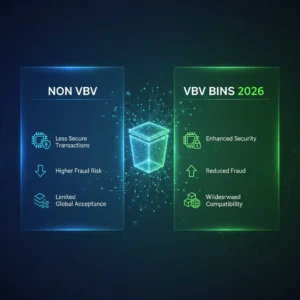
How VBV and Non VBV Actually Differ
VBV Enrolled
The bank requires authentication. Checkout redirects to the bank page. An OTP or password is entered. If it matches, the transaction proceeds and the bank carries fraud liability.
Non VBV Enrolled
The bank does not require authentication. Checkout authorizes directly. No redirect, no prompt, no code. The merchant carries fraud liability if the transaction turns out to be unauthorized.
That liability difference is the reason banks enroll ranges in the first place. Enrolling shifts risk to the merchant. Not enrolling keeps friction low for the bank customers but leaves the merchant exposed.
Why Banks Pick One Over the Other
Size of the institution. Large banks enroll almost everything because the liability shift is worth the friction. Smaller banks and credit unions often skip enrollment because implementation costs money and their customers complain about extra steps.
Product type. Debit and prepaid products are enrolled less often than credit cards. Prepaid in particular is inconsistent because the issuer has no ongoing relationship with the cardholder.
Region. European banks moved to near universal enrollment under PSD2. US banks lagged, and many credit unions still have not enrolled.
Legacy infrastructure. Some banks run card management systems that predate 3DS support. Their ranges are non VBV by technical limitation rather than deliberate choice.
Why the Gateway Decides More Than the BIN
The gateway sitting between the merchant and the bank has its own configuration, and that configuration can override the BIN.
Stripe. 3DS is optional by default but newer integrations increasingly force it. A non VBV BIN can still hit a challenge on a Stripe merchant with enforcement turned on.
Adyen. Enforces 3DS aggressively and will override a non VBV BIN at the gateway level. Always test before committing volume.
Authorize.net. Many legacy merchants still run with 3DS disabled entirely. These are the closest thing to true 2D sites left in 2026.
Braintree. Requests 3DS but does not always enforce it. Behaviour varies by merchant configuration.
International processors. Minimal enforcement in most cases. AVS is often not applied at all.
Knowing the BIN status is only half the picture. Knowing which gateway sits behind the merchant is the other half.
Why Testing Beats Any List
Here is the part that separates operators who stay productive from operators who burn cards.
A BIN list, no matter how fresh, describes historical behaviour. Testing describes current behaviour. The gap between the two is where most declines happen.
Enrollment changes silently. Banks do not publish enrollment updates. The only way to know a range has been enrolled is to test it and watch a challenge fire.
Gateway configs change silently. A merchant can flip 3DS enforcement on or off without any visible change to the site. The checkout looks identical. The outcome is not.
Merchant rules change silently. Amount thresholds, first time buyer checks and category restrictions get adjusted constantly. A range that cleared last month may not clear this month on the same merchant.
Testing is not an optional step. It is the only step that produces current information.
How to Test Properly
Run a live check first. Confirm enrollment status and look for gateway specific notes rather than a simple yes or no. nonvbvshop.net, cvvplug.to and fullzplug.to ship integrated checkers that report per gateway behaviour.
Cross reference recent reports. Has anyone run this range on the specific gateway you are targeting in the last 30 days? Older reports are unreliable.
Test with a micro transaction. A $1 to $5 purchase on the target merchant tells you more than any database. If a challenge fires, the range is not non VBV on that gateway no matter what the checker said.
Log the result. BIN, gateway, merchant, amount, outcome. Over time this log becomes the only list that stays accurate.
Matching Signals to Avoid False Declines
A clean BIN still fails if the session signals do not line up.
Proxy location. Residential SOCKS5 in the cardholder city. Datacenter IPs are flagged before the AVS check even runs.
Browser fingerprint. Canvas hash, WebGL, audio context, fonts, timezone, language and screen resolution all need to match. Free browsers handle two or three of those layers and leak the rest.
Billing alignment. Proxy city, timezone, language header and shipping region should all match the billing ZIP.
Session warmth. Landing directly on checkout and paying within 30 seconds is a textbook fraud pattern. Browse first, then check out.
Transaction size. Small first orders clear more often than large ones. Scale after repeated success, not before.
What Shifted in 2026
Enrollment accelerated across the board. Visa and Mastercard pushed 3DS into more merchant categories. The pool of reliably non VBV ranges shrank.
Guest checkout became rarer. More merchants require accounts, which adds behavioural scoring to the transaction.
AI risk scoring became standard. Stripe Radar and Adyen RevenueProtect evaluate typing cadence, dwell time and device language alongside the card data. Signal mismatches now trigger challenges even on ranges that would have cleared a year ago.
International merchants became the easiest lane. Wholesale and cross border marketplaces still run processors with minimal checks and inconsistent AVS.
Gift cards became the primary cashout. Digital codes deliver in minutes, add separation between card and cashout and convert to crypto through P2P exchanges.
Common Questions
What does non VBV actually mean?
A card range the issuing bank has not enrolled in Verified by Visa or Mastercard SecureCode. On compatible merchants, the transaction skips the 3DS challenge.
Can a non VBV BIN still trigger 3DS?
Yes. Gateway level enforcement overrides BIN status. Stripe and Adyen both do this.
Why do some banks skip enrollment?
Cost, customer friction and legacy infrastructure. Smaller institutions, debit products and prepaid cards are enrolled less often.
Why is testing more important than any list?
Because enrollment, gateway configs and merchant rules all change without notice. A list describes the past. A test describes the present.
How do I confirm a range is non VBV?
Live checker with gateway notes, recent community reports and a micro transaction on the target merchant. Document the outcome.
Where do verified ranges come from?
nonvbvshop.net, cvvplug.to and fullzplug.to carry live tested ranges with per gateway verification and escrow protection.
What is the biggest mistake?
Treating non VBV as a fixed label. It is a test result tied to a specific gateway and merchant combination.
Final Word
Non VBV is not something a card is. It is something a transaction does, on a particular merchant, through a particular gateway, at a particular moment. That is why lists go stale and why checkers disagree.
Source fresh ranges from nonvbvshop.net, cvvplug.to and fullzplug.to. Verify per gateway. Test small. Match every signal. Log every result. The operators who treat it as a test rather than a label are the ones still clearing transactions in 2026.
Disclaimer: This content is for educational and informational purposes only. The information provided is based on publicly available research and does not constitute encouragement of illegal activities. Always comply with applicable laws and regulations.