
The best advanced non VBV BIN checker, non VBV BIN lookup, free online non VBV checker, or a reliable BIN checker, you’ll quickly discover that not every BIN database provides the same information.
Some tools focus on basic issuer identification. Others provide country, card type, network, funding type, product information, APIs, bulk lookups, or additional risk data.
There’s also an important distinction between checking a BIN and determining how a particular payment will be authenticated.

A BIN checker can identify card-related metadata. It cannot guarantee whether a future transaction will require 3D Secure, pass a merchant’s fraud controls, or be approved.
Visa itself recommends using authorized and current BIN data for payment-related use cases and warns that inaccurate third-party BIN data can contribute to payment acceptance problems.
What Is a BIN Checker?
Must checkNon VBV Bins 2026 – The Private Non VBV BIN List That Still Prints
A BIN checker is a lookup tool that identifies information associated with a Bank Identification Number.
A BIN is part of the identifier used to associate a payment card with an issuer or card range.
Depending on the database, a lookup can return information such as:
- Card network
- Issuing bank
- Issuing country
- Card type
- Funding type
- Card product
- BIN/IIN
- Account-range information
What Does advanced Non VBV BIN Checker Mean?
The phrase “non VBV BIN checker” is mostly an informal search term.
It generally refers to a BIN checker that people use when researching BINs described online as “non-VBV.”
However, non-VBV isn’t an official Visa or Mastercard BIN classification.
A legitimate BIN checker can tell you about a card range and issuer. It shouldn’t be treated as a tool that guarantees a card will avoid authentication.
Modern payment authentication can involve 3D Secure, issuer risk assessment, device signals, and other security controls.
What Can a BIN Checker Actually Tell You?
A good checker can provide useful metadata.
Issuing bank
The database may identify the financial institution associated with the BIN.
Country
The result may show the country associated with the issuing range.
Card network
For example:
- Visa
- Mastercard
- American Express
- Discover
- JCB
- UnionPay
Card type
Depending on the database, you may see:
- Credit
- Debit
- Prepaid
Funding type
Some databases provide additional funding classifications.
Product
Certain datasets provide information about the card product or program.
The exact fields depend on the provider and its underlying data.
Best Non VBV BIN Checker: What Should You Look For?
If you’re comparing BIN checkers in 2026, I’d focus on five things.
1. Data freshness
Payment-card information changes.
Visa says recipients of its BIN Attribute data should update their tables daily or weekly, and at minimum every two weeks. (Visa)
That illustrates why a BIN database that hasn’t been updated recently can become problematic.
2. Eight-digit BIN support
Modern BIN infrastructure increasingly uses eight-digit identifiers.
Visa describes BINs as six- to eight-digit numbers and provides account-range lookup capabilities through its BIN services. (Visa)
A modern checker should therefore handle current BIN structures rather than relying exclusively on old six-digit assumptions.
3. Data transparency
Look for a provider that explains:
- Where its data comes from
- When it was updated
- Which attributes it provides
- Whether it supports APIs
- How it handles privacy
4. Privacy
A normal BIN lookup shouldn’t require you to submit an entire card number.
For ordinary BIN research, the relevant information is the BIN/IIN prefix, not the complete payment-card number.
Never paste a full card number into an unfamiliar BIN website.
5. Useful output
A good checker should provide meaningful issuer information instead of returning only a generic “Visa” or “Mastercard” result.
BIN Checker Comparison
Here are some types of BIN tools worth considering:
| Tool type | Best for | What to look for |
|---|---|---|
| Free BIN checker | Occasional lookups | Issuer, country, network, type |
| BIN database | Research | Search and filtering |
| BIN API | Developers | Structured JSON and documentation |
| Enterprise BIN data | Payment businesses | Current authorized data |
| Bulk BIN tool | Large datasets | Export and batch processing |
For businesses processing real payments, official or authorized data sources are preferable to random internet BIN lists.
Official Visa BIN Data
For professional payment use cases, Visa offers its BIN Attribute Sharing Service (VBASS).
Visa says its service can provide information such as issuer, product, country, and funding source, and supports both single-BIN lookups and full BIN/account-range files.
Visa also specifically emphasizes the importance of using current and authorized BIN tables.
This is an important distinction between a casual free BIN website and an authoritative payment-data source.
Free BIN Checkers
Free checkers can be useful when you only need basic information.
For example, some current free tools advertise lookup of issuer, network, country, and card type without requiring registration.
They’re convenient for occasional research.
However, free doesn’t automatically mean accurate.
The most important question is where the underlying BIN information comes from and how frequently it is refreshed.
BINCheck
BIN Checker offers a public BIN lookup tool and says its database contains more than 3.5 million BIN records. It provides issuer, brand, country, and funding information and also offers API and bulk-lookup functionality.
Best for: quick lookups and developers who need an API.
One useful feature is its distinction between ordinary lookup and more advanced API functionality.
BinList-Style BIN Lookup
Simple BIN databases are useful when you only need basic issuer information.
A basic checker can be enough if your goal is simply to determine:
- Issuer
- Country
- Card network
- Card type
You don’t necessarily need an enterprise API for a single lookup.
The important thing is to understand that basic databases may not provide the same depth or freshness as official payment-network data.
API-Based BIN Checkers
Developers may prefer a BIN API instead of manually visiting a website.
An API can allow software to automatically retrieve information such as:
- Issuer
- Network
- Card type
- Country
- Product
- Funding type
This can be useful for ecommerce platforms that need to identify card metadata during checkout.
BIN Checker vs BIN Database
These terms are related but slightly different.
A BIN checker is usually the interface used to look up an individual BIN.
A BIN database is the underlying collection of issuer and account-range information.
Think of it like this:
BIN database → stores the information
BIN checker → searches the information
Some companies provide both.
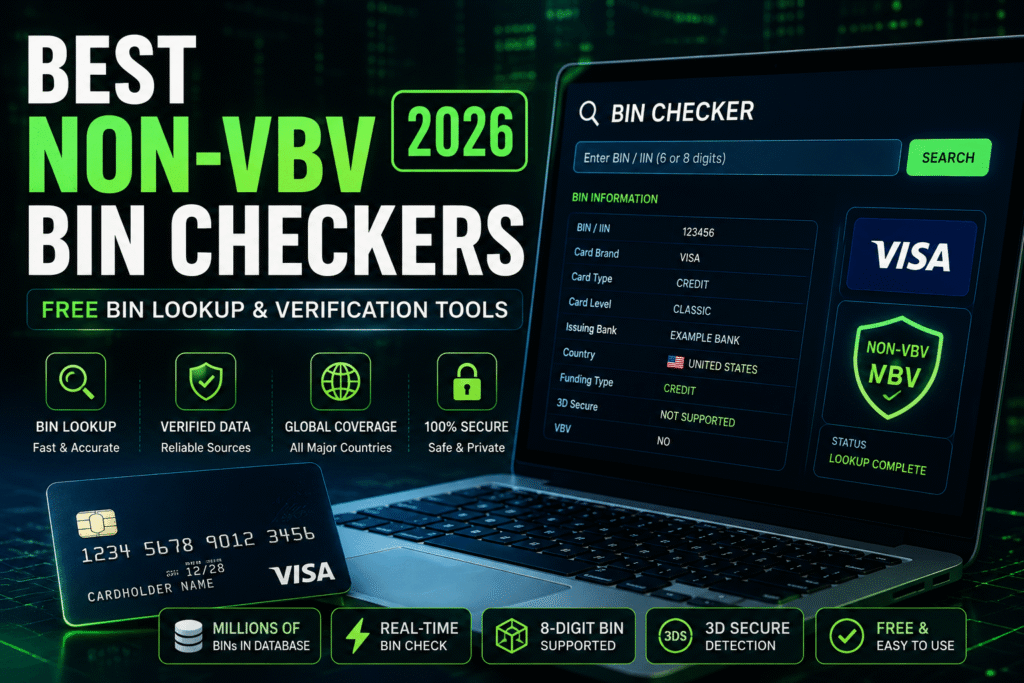
Can a BIN Checker Identify a Non-VBV BIN?
This is where you need to be careful.
A third-party checker may display a label such as:
VBV: No
or:
3DS: Not supported
But that doesn’t necessarily mean that the result is an authoritative prediction of what will happen during a future transaction.
Authentication can depend on the issuer, merchant, transaction, regulations, and risk systems.
Therefore, treat third-party “non-VBV” labels as database metadata, not guarantees.
Does a Non VBV BIN Mean No 3D Secure?
No.
Modern 3D Secure isn’t simply an OTP screen.
Authentication can involve:
- Risk-based decisions
- Banking-app approval
- Device authentication
- Biometrics
- One-time codes
- Other issuer-controlled methods
A transaction that doesn’t display an obvious OTP challenge can still involve authentication or risk evaluation.
Why Old BIN Checkers Can Be Wrong
BIN information isn’t static.
Card programs change.
Issuers introduce new products.
Account ranges are updated.
Payment networks evolve.
Third-party databases can therefore become inaccurate if they aren’t regularly refreshed.
Visa has explicitly warned about the importance of authorized, current BIN data and reported significant inaccuracies in third-party BIN datasets it analyzed. (Visa)
That’s a strong reason not to judge a checker purely by the number of BINs it claims to contain.
Six-Digit vs Eight-Digit BIN Lookup
Older BIN tools often focus on six digits.
Modern payment infrastructure increasingly supports eight-digit BINs and account ranges.
This matters because additional digits can provide more precise identification within the payment-card ecosystem.
If you’re choosing a BIN checker in 2026, look for explicit support for modern BIN structures.
What a BIN Checker Cannot Tell You
A BIN lookup is not a window into someone’s bank account.
It generally cannot tell you:
- Current account balance
- Available credit
- PIN
- CVV
- Password
- Transaction history
- Private banking credentials
A legitimate BIN checker should be dealing primarily with card and issuer metadata.
Why High Balance non vbv BIN Searches Are Misleading
You may encounter searches for high balance BINs.
A BIN doesn’t tell you the current balance of an individual card.
Thousands of cards can share the same issuer range while having completely different balances, limits, and transaction histories.
Therefore, a BIN database cannot legitimately determine that a specific card has a particular balance.
Why You Shouldn’t Enter a Full Card Number
This is one of the most important practical rules.
For a normal BIN lookup, you generally only need the BIN/IIN prefix.
You should not submit a full card number, CVV, PIN, or banking password to an unknown BIN website.
Some current BIN tools explicitly instruct users to enter only the first six to eight digits rather than the full card number. (Card BIN Checker)
If a site unexpectedly asks for complete payment credentials just to identify an issuer, that’s a major red flag.
How to Choose the Best BIN Checker
Before using a BIN lookup service, ask:
Is the data current?
Check the last update or refresh information.
Does it support modern BIN structures?
Eight-digit BIN and account-range support are useful indicators.
Does it explain its source?
Transparent data sourcing is preferable.
Does it protect sensitive information?
You shouldn’t need to provide unnecessary payment credentials.
Does it provide useful attributes?
At minimum, look for issuer, country, network, and card type.
Does it offer an API?
This matters if you’re integrating BIN information into a website or payment system.
Best BIN Checker for Different Uses
For occasional lookups
A straightforward free BIN checker is usually enough.
For developers
An API-based service is more convenient because lookups can be automated.
For ecommerce
Look for current data and integration capabilities that support fraud management and payment operations.
For enterprise payment processing
Official or authorized network data is preferable to an anonymous third-party BIN list.
Visa’s own BIN services are specifically designed for payment-industry use cases such as authorization management, fraud reduction, and checkout optimization. (Visa)
Are Free BIN Checkers Accurate?
Some can be useful, but accuracy varies.
A free checker may be perfectly adequate for identifying the basic issuer and country of a BIN.
However, businesses making payment decisions should be more cautious.
Visa’s research has shown why relying on unverified third-party BIN tables can create payment-acceptance problems. (Visa)
For production payment systems, current authorized data is the safer approach.
Non-VBV BIN Checker vs Normal BIN Checker
There isn’t necessarily a technical difference.
A normal BIN checker identifies card metadata.
A website marketing itself as a non-VBV BIN checker may simply add additional labels or filters related to authentication terminology.
Those labels shouldn’t automatically be treated as official network attributes.
Frequently Asked Questions
What is the best non VBV BIN checker?
For legitimate BIN research, choose a checker with current data, clear sourcing, modern BIN support, useful issuer attributes, and good privacy practices.
What is a BIN checker?
A BIN checker is a lookup tool that identifies information associated with a payment-card BIN or IIN.
Can a BIN checker tell me the issuing bank?
Yes. Issuer information is one of the most common attributes returned by BIN lookup tools.
Can a BIN checker identify the card country?
Many BIN databases provide the country associated with the issuer or card range.
Does a BIN checker tell you whether a payment will succeed?
No. BIN metadata doesn’t guarantee authorization.
Can a BIN checker tell you whether a card is non-VBV?
Some third-party databases may provide such a label, but it isn’t an official guarantee of the transaction’s authentication behavior.
Are free BIN checkers safe?
It depends on the provider. Avoid services that request unnecessary sensitive information and check how they handle your data.
Should I enter my full card number?
No. A normal BIN lookup only requires the relevant BIN/IIN prefix. Never provide your CVV, PIN, password, or other banking credentials to an unfamiliar lookup service.
Are six-digit BINs still relevant?
Yes, but modern payment infrastructure also uses eight-digit BINs and account-range data.
Final Verdict
If you’re searching for the best non-VBV BIN checker in 2026, don’t choose a tool simply because it advertises the largest BIN list or claims to identify “working” payment cards.
Look for current data, transparent sourcing, modern BIN support, useful issuer attributes, and strong privacy practices.
For casual lookups, a reputable free checker can be enough.
For businesses and payment systems, authoritative and current BIN data is much more important. Visa itself provides official BIN attribute services and recommends using authorized, current BIN tables rather than relying on random internet lists.
Most importantly, remember what a BIN checker actually does:
It identifies card metadata. It doesn’t guarantee authentication, payment approval, or transaction success.
That’s the distinction that separates a useful BIN lookup from the exaggerated claims found on many low-quality BIN-list websites.