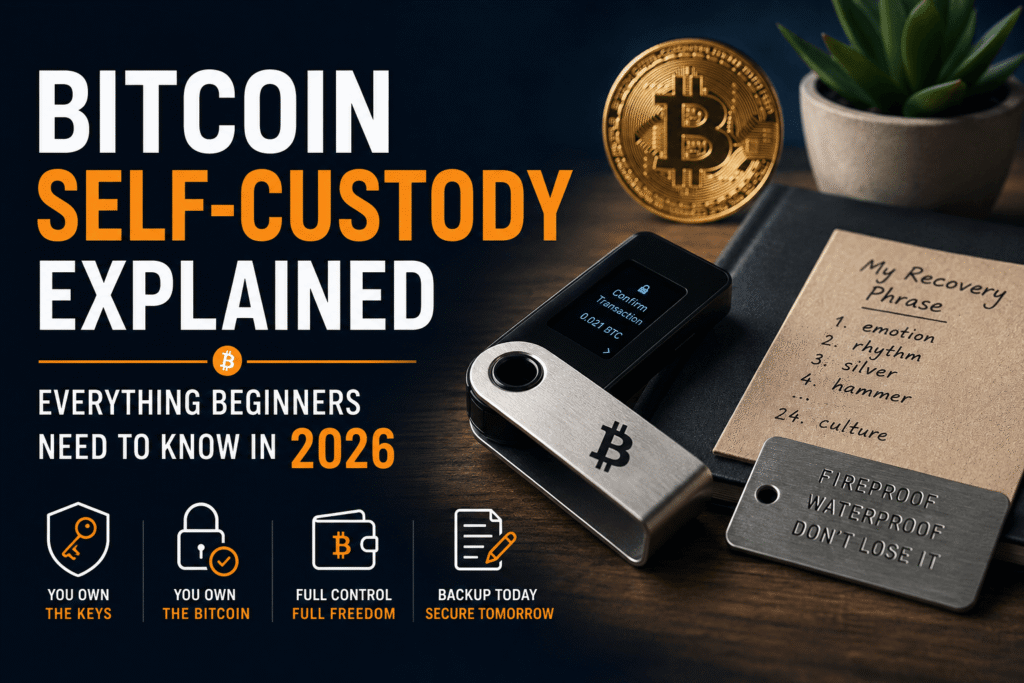

Bitcoin gives you the ability to own digital money without relying on a bank, but true ownership comes with responsibility. If you leave your Bitcoin on an exchange, the company not you ultimately controls the private keys that authorize transactions. Bitcoin self-custody changes that by putting you in complete control of your funds. This guide explains what self-custody is, how it works, its advantages and risks, and the steps beginners should take to protect their Bitcoin safely in 2026.
What Is Bitcoin Self-Custody?
Bitcoin self-custody means storing your Bitcoin in a wallet where you control the private keys.
Instead of trusting an exchange or another company to safeguard your Bitcoin, you become responsible for securing it yourself.
The phrase “Not your keys, not your coins” is widely used in the Bitcoin community because whoever controls the private keys ultimately controls the Bitcoin.
Self-custody doesn’t mean your Bitcoin is stored on your phone or hardware wallet. Your Bitcoin always exists on the Bitcoin blockchain. Your wallet simply stores the cryptographic keys needed to access and spend it.
Why Does Self-Custody Matter?
Many beginners buy Bitcoin through exchanges and leave it there indefinitely.
While this may be convenient, it also means trusting another company to protect your funds.
Potential risks include:
- Exchange hacks
- Frozen accounts
- Withdrawal restrictions
- Bankruptcy
- Regulatory issues
- Account suspension
With self-custody, no company can freeze your wallet or stop you from accessing your Bitcoin as long as you keep your recovery information safe.
Self-Custody vs Custodial Wallets
Custodial Wallet
A custodial wallet is managed by a third party.
Examples include many cryptocurrency exchanges and hosted wallet services.
Advantages:
- Easy for beginners
- Password recovery
- Customer support
- Convenient buying and selling
Disadvantages:
- You don’t control the private keys.
- Accounts may be frozen.
- Withdrawals may be delayed.
- The company becomes a security risk.
Self-Custody Wallet
A self-custody wallet gives you complete ownership.
Advantages:
- Full control
- Greater privacy
- No permission required to send Bitcoin
- No exchange risk
Disadvantages:
- You’re responsible for security.
- Losing your recovery phrase could permanently lock you out of your Bitcoin.
- Mistakes cannot usually be reversed.
Understanding Private Keys
A private key is a secret cryptographic number that proves ownership of Bitcoin.
Think of it like the master key to a vault.
Anyone with your private key can move your Bitcoin.
For that reason, you should never:
- Share it
- Email it
- Upload it to cloud storage
- Store it in screenshots
- Send it through messaging apps
Your wallet manages these keys automatically, but you remain responsible for protecting access to them.
What Is a Recovery Phrase?
When creating most Bitcoin wallets, you’ll receive a recovery phrase.
This usually consists of 12 or 24 words generated in a specific order.
Examples might look like:
river
forest
orange
planet
…
These words are essentially a backup of your wallet.
If your phone breaks or your hardware wallet is lost, the recovery phrase allows you to restore access.
Anyone who knows these words can also restore your wallet.
Protect them carefully.
Hot Wallets vs Cold Wallets
Hot Wallet
A hot wallet is connected to the internet.
Examples include:
- Mobile wallets
- Desktop wallets
- Browser wallets
Pros:
- Convenient
- Fast transactions
- Easy to use daily
Cons:
- Greater exposure to malware
- Phishing risks
- Device theft
Cold Wallet
A cold wallet stores private keys offline.
The most common example is a hardware wallet.
Pros:
- Excellent security
- Better for long-term storage
- Resistant to online attacks
Cons:
- Costs money
- Slightly less convenient
- Requires learning basic backup procedures
Many experienced Bitcoin holders use:
- Hot wallets for spending
- Cold wallets for savings
How to Set Up a Self-Custody Wallet
Step 1
Choose a reputable Bitcoin wallet.
Research:
- Security history
- Open-source status
- Community reputation
- Backup options
- Compatibility
Step 2
Download only from the official source.
Never install wallets from random websites or advertisements.
Step 3
Create a new wallet.
The wallet will generate:
- Private keys
- Recovery phrase
- Receiving addresses
Step 4
Write down your recovery phrase.
Use permanent ink.
Double-check spelling.
Store it securely.
Step 5
Verify the backup.
Many wallets ask you to confirm the words before continuing.
Do not skip this step.
Step 6
Receive a small Bitcoin test transaction.
Always test with a small amount before transferring larger balances.
How to Store Your Recovery Phrase Safely
Best practices include:
- Keep multiple secure backups.
- Store them in separate locations.
- Protect against fire and water damage.
- Never photograph the words.
- Never upload them online.
- Never store them in email drafts.
- Never type them into websites.
Some users also choose durable metal backup plates designed to survive fire or flooding.
Common Beginner Mistakes
Leaving Everything on an Exchange
Convenient doesn’t always mean safest.
Large balances are often better suited to self-custody.
Sharing Recovery Phrases
No legitimate company will ever ask for your recovery phrase.
If someone asks for it, assume it’s a scam.
Sending Bitcoin to the Wrong Address
Bitcoin transactions generally cannot be reversed.
Always:
- Verify the address.
- Double-check the first and last characters.
- Send a small test amount first.
Falling for Phishing Websites
Attackers often copy exchange or wallet websites.
Protect yourself by:
- Bookmarking official websites.
- Checking URLs carefully.
- Avoiding links in unexpected emails.
Ignoring Device Security
Your wallet is only as secure as the device running it.
Keep:
- Your operating system updated.
- Antivirus software current.
- Screen locks enabled.
- Two-factor authentication active where available.
Is Self-Custody Right for Everyone?
Not necessarily.
Someone buying small amounts while learning Bitcoin may initially feel more comfortable using a reputable exchange.
As their holdings grow, many people decide to move some or all of their Bitcoin into self-custody.
The right approach depends on:
- Your experience
- Your technical confidence
- The amount of Bitcoin involved
- Your personal security practices
Many people choose a hybrid approach:
- Small spending balance in a hot wallet.
- Long-term savings in a cold wallet.
Best Practices for Bitcoin Self-Custody
Follow these habits:
- Buy only from reputable services.
- Keep software updated.
- Enable two-factor authentication where available.
- Use strong, unique passwords.
- Verify Bitcoin addresses before sending.
- Keep your recovery phrase offline.
- Test backups before storing significant funds.
- Never tell strangers how much Bitcoin you own.
- Beware of investment scams promising guaranteed returns.
Frequently Asked Questions
Is self-custody safer than leaving Bitcoin on an exchange?
Self-custody removes reliance on an exchange but makes you responsible for securing your wallet and recovery phrase.
Can I lose my Bitcoin?
Yes. If you lose your recovery phrase and no longer have access to your wallet, your Bitcoin may be permanently inaccessible.
Can someone hack my hardware wallet?
Hardware wallets are designed to keep private keys offline, making them much harder to compromise remotely. However, users still need to protect their recovery phrase and verify they are interacting with legitimate software.
Should beginners use self-custody?
Many beginners start with small amounts to learn how wallets work before moving larger holdings into self-custody.
Can I have more than one wallet?
Yes. Many people use one wallet for everyday spending and another for long-term savings.
Final Thoughts
Bitcoin self-custody gives you complete ownership of your digital assets, but that ownership comes with responsibility. By understanding private keys, protecting your recovery phrase, using trusted wallet software, and following good security practices, you can significantly reduce the risk of losing your Bitcoin.
For many beginners, the journey starts with buying small amounts through a dollar-cost averaging (DCA) strategy. As your confidence grows, learning self-custody is one of the most important steps toward becoming a more informed and secure Bitcoin holder.