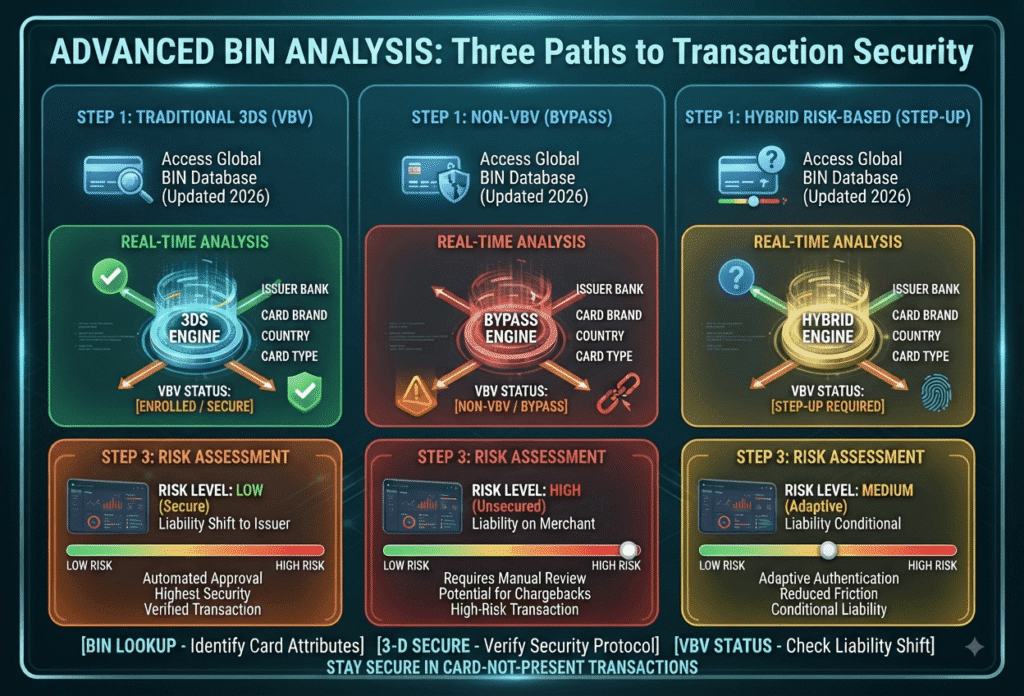

If you are searching for how to check non VBV BINs, or using free non vbv checker, the first thing to understand is that a BIN lookup can provide useful information about a card’s issuing institution, network, country, and card type but it does not reliably guarantee how a particular transaction will be authenticated.
In 2026, payment authentication can depend on the issuer, merchant, transaction, risk assessment, and whether 3-D Secure is triggered. That makes older static “non VBV BIN lists much less reliable than they may appear.
This guide shows what you can actually check with a BIN lookup and how to interpret VBV and 3-D Secure information.

After doing alot of research i found this working A must check non vbv checker tool
What Is a BIN?
A BIN, or Bank Identification Number, is the initial portion of a payment card number used to identify information associated with the card issuer and payment network.
Modern payment systems can use expanded IIN ranges, but “BIN” remains the common term used by many BIN lookup services.
A legitimate BIN lookup may provide information such as:
- Issuing bank or institution
- Card network
- Country
- Credit, debit, or prepaid classification
- Card level or product type
- Sometimes additional issuer or geographic information
However, BIN information should not be confused with information about an individual cardholder.
Looking for Non VBV Bins 2026 – The Private Non VBV BIN List That Still Prints
How to Check a BIN
The simplest approach is to use a reputable BIN lookup database.
Enter the BIN or IIN into the lookup service and review the information returned. Depending on the database, you may see the issuer, network, country, card type, and other attributes.
For example, a lookup might tell you that a particular BIN belongs to a certain card network and issuer and is classified as a debit card.
That information is useful for identifying the card product, but it does not automatically tell you whether a transaction will require 3-D Secure.
How to Check Non VBV BINs
This is where many online BIN lists become misleading.
A BIN database may contain fields associated with 3-D Secure, authentication, or verification, but those fields should be treated as informational rather than a guaranteed prediction of transaction behavior.
There isn’t a universal BIN attribute that guarantees that every card under a particular BIN will always be “non VBV.”
Authentication can depend on factors including:
- The card issuer
- The merchant
- The transaction
- The country and region
- The payment processor
- Risk-based authentication
- 3-D Secure configuration
- Changes made by the issuer
Therefore, a BIN appearing on an old “non-VBV BIN list” does not necessarily mean that every card using that BIN will behave the same way.
How to Know if a Card Uses 3-D Secure
3-D Secure (3DS) is an authentication framework used by payment networks and issuers to add an additional layer of verification to online transactions.
The exact authentication experience can vary.
A transaction may involve:
- No additional customer interaction
- A verification prompt
- An issuer authentication page
- A one-time code
- Biometric authentication
- Another form of issuer-approved verification
Importantly, whether authentication occurs can be determined dynamically rather than solely from the BIN.
This means you should not assume that a BIN marked “VBV” or “non VBV” in a third-party database will behave identically in every transaction.
Is There a Non VBV BIN Checker?
There are many websites that advertise themselves as non VBV BIN checkers, but their accuracy can vary considerably.
A useful BIN checker should provide clear information about the source and freshness of its database.
Before relying on a BIN lookup, check whether it provides:
- Issuer information
- Card network
- Card type
- Country
- BIN/IIN range
- Database update information
- Clear explanations of its data fields
Be cautious with websites that promise that a BIN checker can guarantee whether a transaction will bypass authentication. A database lookup cannot reliably predict every issuer’s real-time authentication decision.
How to Identify a BIN
A BIN is normally obtained from the beginning of a payment card number.
However, you should never publish or share a complete payment card number just to perform a BIN lookup.
For informational research, use only the BIN/IIN portion required by the lookup service and avoid exposing sensitive payment credentials.
A BIN lookup is designed to identify attributes associated with the issuing range not to reveal private cardholder information.
Is This BIN VBV?
If you are asking whether a particular BIN is “VBV,” the answer may not be as straightforward as an online list suggests.
Older databases sometimes classify BINs using labels such as:
- VBV
- Non-VBV
- 3DS
- Non-3DS
- Secure
- Not Secure
These labels can become outdated.
Issuers can change authentication policies, processors can change their implementations, and payment systems can apply risk-based decisions. Consequently, a historical database entry shouldn’t be treated as a permanent property of every card in that BIN range.
Are Free BIN Lists Accurate?
Free BIN lists can be useful for basic research, but their quality varies.
A list that has not been updated recently may contain:
- Old issuer names
- Incorrect card classifications
- Outdated country information
- Retired BIN ranges
- Incorrect authentication information
This is one reason a current BIN lookup database is generally more useful than downloading an old static PDF and assuming every entry remains accurate.
Why Static Non VBV BIN Lists Become Outdated
The payment ecosystem changes continuously.
Banks can migrate portfolios, payment networks can introduce new BIN ranges, and issuers can change authentication requirements.
A list created months or years ago may therefore describe historical conditions rather than the current state of a card program.
For SEO purposes, this is also why pages promising a permanent “2026 non-VBV BIN list” should be approached carefully.
What a BIN Checker Can and Cannot Tell You
A BIN lookup is useful for identifying information associated with a card range.
A BIN checker can often tell you:
- Issuer
- Network
- Country
- Card type
- Product category
- BIN/IIN range information
A BIN checker cannot reliably guarantee:
- Whether a specific transaction will be approved
- Whether authentication will be triggered
- Whether a particular cardholder will pass authentication
- Whether a card will work with a particular merchant
- Whether an issuer’s authentication policy will remain unchanged
This distinction is important when evaluating BIN information online.
BIN Lookup vs. VBV Status
These are related but different concepts.
BIN lookup answers questions about the card range and its associated attributes.
VBV/3-D Secure status concerns how online transactions may be authenticated.
A BIN lookup can provide clues or database classifications, but it should not be treated as a real-time authentication oracle.
That is especially important when comparing information from different BIN databases.
How to Choose a BIN Checker
If your goal is legitimate payment research, choose a service that prioritizes current and transparent BIN data.
Look for:
- Recently updated data — payment card ranges change over time.
- Multiple card attributes — issuer, network, country, and card type are useful together.
- Clear data sources — avoid services that make unexplained guarantees.
- Privacy-conscious design — don’t submit complete card credentials unnecessarily.
- Accurate terminology — distinguish BIN information from real-time transaction authentication.
A good BIN checker should help you understand a card range, not promise that a particular transaction will avoid security controls.
Common Mistakes When Checking BINs
1. Treating a BIN list as permanent
A BIN classification can become outdated.
2. Assuming every card in a BIN behaves identically
Issuer and transaction-level decisions can affect authentication.
3. Confusing BIN data with transaction approval
A BIN lookup doesn’t determine whether a payment will be approved.
4. Trusting old PDF lists
Static lists can contain obsolete information.
5. Sharing complete card numbers
There is rarely a legitimate reason to expose a full payment card number for a basic BIN lookup.
Frequently Asked Questions
How do I check non VBV BINs?
Use a reputable BIN/IIN lookup to examine the card range and any available authentication-related metadata. Treat “non VBV” classifications as informational rather than a guarantee of transaction behavior.
How do I know if a BIN is VBV?
A third-party database may provide a VBV or 3-D Secure classification, but that information may not reflect the issuer’s current transaction-level authentication behavior.
What is the best BIN checker?
The best option is generally one with current BIN/IIN data, transparent information sources, useful issuer and network fields, and clear limitations around authentication predictions.
How do I identify a BIN?
Use the BIN/IIN portion of the card number with a reputable lookup service. Do not submit or publish the complete card number unnecessarily.
Are non VBV BIN lists reliable?
They can be useful as historical or informational references, but static lists should not be treated as guaranteed or permanently accurate.
Can a BIN checker guarantee 3-D Secure status?
No. BIN databases can provide associated metadata, but real-world authentication can depend on the issuer, merchant, processor, transaction, and risk assessment.
Final Thoughts
If you want to check a BIN, start with current BIN/IIN information rather than relying on an old static list.
The most important distinction is that BIN identification and transaction authentication are not the same thing. A lookup can tell you a great deal about a card range, but it cannot guarantee what authentication experience a particular transaction will receive.
For 2026, the safest approach is to treat “VBV” and “non VBV” labels as database classifications rather than permanent characteristics. Use current information, protect payment credentials, and avoid services that promise guaranteed authentication outcomes.