
The terms non VBV banks, non VBV BINs, MSC BINs, non VBV sites, and non vbv BIN checkers continue to appear frequently in online searches in 2026.
The terminology can be confusing, however, because the payment industry has moved well beyond the older idea of simply labeling cards as “VBV” or “non VBV.” Modern online payments can use EMV 3-D Secure, risk-based authentication, frictionless authentication, and additional verification depending on the transaction.

What Does Non VBV Mean?
VBV traditionally referred to Verified by Visa, an older name associated with Visa’s online cardholder authentication system.
Visa has since moved to the Visa Secure branding as part of the modern EMV 3-D Secure ecosystem.
The phrase non-VBV is therefore mostly an informal internet term. It is commonly used to describe a card or transaction that does not appear to go through the traditional Verified by Visa experience.
That does not necessarily mean the transaction has no security checks.
Modern authentication can happen without the customer seeing a separate verification screen.
What Are Non VBV Banks?
A non-VBV bank is generally described online as a bank whose cards do not appear to use traditional Verified by Visa authentication.
However, there is no universal banking classification called “non-VBV bank.”
Authentication can vary according to:
- Card product
- Issuing bank
- Payment network
- Merchant
- Payment processor
- Country
- Transaction type
- Transaction risk
- Device information
- Previous transaction history
As a result, a bank should not automatically be considered permanently “non-VBV” simply because one card or transaction did not display an authentication challenge.
Is There a Reliable List of Non VBV Banks in 2026?
Static lists should be treated cautiously.
Banks regularly change card products, authentication systems, processors, and fraud-prevention policies. A list published several years ago may therefore no longer accurately describe how those cards behave today.
Even cards from the same issuer can have different authentication characteristics.
For legitimate research, the best approach is to verify information through current issuer, network, processor, or payment documentation rather than relying on an old list claiming that particular banks are permanently non-VBV.
What Are Non VBV BINs?
A BIN, commonly called a Bank Identification Number, identifies information associated with a payment-card issuing range. The industry also uses the term IIN, or Issuer Identification Number.
A BIN database may provide information such as:
- Issuer
- Country
- Payment network
- Card type
- Product category
- Commercial or consumer classification
However, a BIN does not permanently determine how a future transaction will be authenticated.
This is one of the biggest misconceptions surrounding non-VBV BIN searches.
BIN Information Does Not Equal Authentication Information
A BIN can help identify a card product.
It cannot reliably guarantee:
- Whether 3-D Secure will be used
- Whether a transaction will receive a challenge
- Whether an OTP will be requested
- Whether a merchant will approve a transaction
- Whether a particular checkout will use a particular authentication flow
Those decisions can happen dynamically during the payment process.
What Is an MSC BIN?
MSC BIN is another phrase that appears in online searches and card databases.
Unlike standardized payment terminology such as BIN/IIN or EMV 3-D Secure, MSC BIN does not have one universally accepted definition across the payment industry.
Different websites and databases may use the abbreviation differently.
If a BIN database uses the term MSC, check its own documentation to determine exactly what it means rather than assuming that every database uses the term identically.
What Is a BIN Checker?
A BIN checker is a lookup service that provides information associated with a BIN or IIN.
A typical legitimate lookup may return:
| Field | Example information |
|---|---|
| BIN/IIN | Issuer identification range |
| Network | Visa or Mastercard |
| Country | Issuing country |
| Issuer | Financial institution |
| Card type | Credit, debit or prepaid |
| Product | Available product classification |
The usefulness of a BIN checker depends on the quality and freshness of its underlying database.
Can a BIN Checker Confirm a Card Is Non VBV?
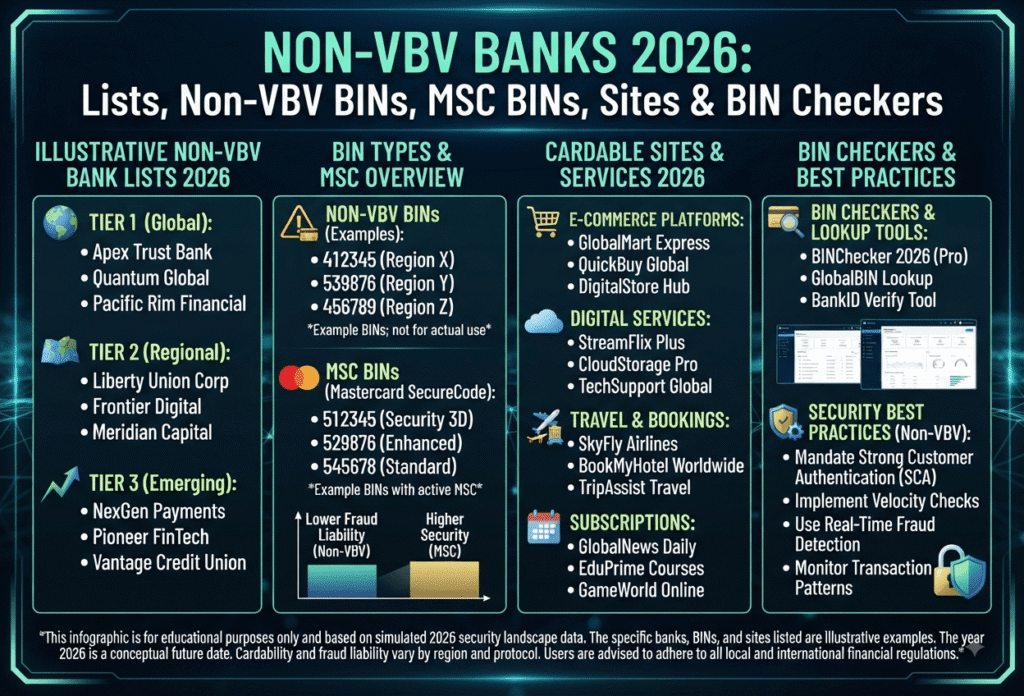
A BIN checker can identify information about the issuer and card product, but authentication decisions occur as part of the payment process.
For example, a BIN database might correctly identify a card as a particular Visa debit product. That does not mean the same card will always have the same authentication experience at every merchant.
This is why claims such as “100% guaranteed non-VBV BIN” should be treated skeptically.
What Are Non VBV Sites?
The term non-VBV sites is commonly used online to describe websites where users claim that card transactions can occur without the traditional VBV authentication experience.
The problem is that the term is not a standardized category of websites.
A website does not necessarily have a permanent “VBV” or “non-VBV” status.
Payment authentication can depend on the merchant’s payment processor, the card network, the issuer, transaction risk, and other factors.
A checkout that does not show an authentication challenge during one transaction may behave differently during another.
Why Non VBV Site Lists Become Outdated
Online lists of supposedly non-VBV websites can become inaccurate quickly.
A merchant can:
- Change payment processors.
- Enable or update 3-D Secure.
- Change its fraud-prevention provider.
- Modify its checkout system.
- Change payment methods.
- Introduce stronger customer authentication.
Consequently, a website described online as “non-VBV” may no longer have the same payment configuration.
For legitimate users, it is better to view these lists as potentially outdated claims rather than authoritative payment-industry classifications.
Non VBV Does Not Mean No Security
One of the most important concepts to understand is that no visible authentication challenge does not necessarily mean no authentication.
Modern 3-D Secure supports different authentication flows.
Frictionless Authentication
With a frictionless flow, authentication information can be evaluated in the background without requiring the customer to complete a visible challenge.
Challenge Authentication
If additional verification is necessary, the issuer can request a challenge.
Depending on the implementation, this could involve additional customer verification.
This distinction explains why an online purchase can sometimes proceed without an OTP or separate authentication page even when modern 3-D Secure infrastructure is involved.
Visa Secure and Modern 3-D Secure
The older Verified by Visa terminology remains popular because it was widely used for years.
Modern Visa authentication is associated with Visa Secure and the EMV 3-D Secure framework.
The modern system is designed to use more information during authentication rather than relying exclusively on a visible password or OTP prompt.
That makes the old “VBV versus non-VBV” distinction much less useful for understanding today’s payment ecosystem.
Mastercard and 3-D Secure
Mastercard also participates in the 3-D Secure ecosystem.
Its consumer-facing authentication solution is known as Mastercard Identity Check.
Therefore, “VBV” should not be treated as a universal term for every card network.
Visa and Mastercard use their own branding and payment infrastructure while participating in the broader 3-D Secure standard.
Why Non VBV Lists Are Often Inaccurate
There are several reasons online lists can conflict.
1. Payment systems change
Banks and merchants regularly update their systems.
2. Different cards behave differently
Two cards from the same bank may belong to different products or portfolios.
3. Authentication is risk-based
The same merchant may not use the exact same authentication flow for every transaction.
4. BIN databases differ
Different databases can contain different or outdated issuer information.
5. Terminology is inconsistent
Terms such as “non-VBV,” “MSC BIN,” and “non-VBV site” are frequently used informally rather than according to standardized industry definitions.
How to Evaluate a BIN Checker
If you’re using a BIN checker for legitimate payment research or merchant operations, consider the following.
Database freshness
Look for information about when the database was last updated.
Issuer accuracy
A useful service should provide reliable issuer information when available.
Network identification
The service should correctly distinguish payment networks.
Card classification
Credit, debit, prepaid, commercial, and consumer classifications can be useful depending on the purpose of the lookup.
Clear limitations
A trustworthy service should explain what its database can and cannot determine.
Are Free BIN Checkers Accurate?
Some free BIN lookup tools can be useful for basic issuer information, but accuracy varies.
The important question is not simply whether a checker is free or paid.
Look at:
- Data freshness
- Number of supported BINs
- Update frequency
- Source of the information
- Accuracy of issuer records
- Transparency about limitations
No BIN checker should be treated as an authoritative predictor of how a particular transaction will be authenticated.
Can a BIN Predict 3-D Secure?
A BIN can provide useful background information, but it cannot reliably predict the complete authentication experience.
The actual transaction can involve multiple parties:
Cardholder → Merchant → Payment Gateway → Payment Network → Issuer
Each part of that ecosystem can affect how the payment is processed.
This is why BIN information and authentication information should be treated as two different categories.
Non VBV Banks vs. Modern 3-D Secure
The following simplified comparison helps clarify the terminology:
| Term | What it generally refers to |
|---|---|
| VBV | Older Verified by Visa terminology |
| Non-VBV | Informal term describing an apparent lack of traditional VBV authentication |
| Visa Secure | Visa’s modern authentication branding |
| 3-D Secure | Modern card-not-present authentication framework |
| Frictionless flow | Authentication completed without a visible challenge |
| Challenge flow | Additional cardholder verification |
| BIN/IIN | Issuer identification information |
| BIN checker | Tool for looking up BIN/IIN information |
Why Merchants Use 3-D Secure
3-D Secure exists primarily to improve security for card-not-present transactions.
Online purchases can involve higher fraud risk because the physical card is not presented to the merchant.
Modern authentication allows issuers and merchants to exchange transaction information and evaluate whether additional verification is appropriate.
The objective is to balance:
Security + Fraud Prevention + Customer Convenience
This is why modern authentication does not always look the same from one checkout to another.
Are Non VBV Cards Still Relevant in 2026?
The keyword certainly remains relevant in search engines, but the underlying terminology is increasingly outdated.
People still search for non VBV cards, non VBV banks, non VBV BINs, and non VBV sites, while payment systems have continued moving toward modern authentication technologies.
For that reason, anyone researching the subject should distinguish between:
- Search terminology
- Payment-industry terminology
- BIN information
- Authentication behavior
They are not interchangeable.
Frequently Asked Questions
What are non VBV banks?
It is an informal term used online for banks or card products believed not to use the traditional Verified by Visa authentication experience. It is not an official banking classification.
Is there a permanent list of non VBV banks?
No. Card products and authentication policies can change, and different cards from the same issuer may have different characteristics.
What are non VBV BINs?
They are BINs informally described as being associated with cards that do not appear to use traditional VBV authentication. A BIN alone cannot guarantee future transaction behavior.
What are non VBV sites?
The term generally refers to websites that users claim do not require traditional VBV authentication during certain transactions. It is not an official classification of merchants.
Can a BIN checker confirm 3-D Secure status?
Not reliably. BIN checkers primarily provide issuer and product information. Actual authentication is determined during the payment process.
Does no OTP mean a card is non VBV?
No. A transaction can use a frictionless authentication flow without displaying a separate OTP or challenge screen.
Is Verified by Visa still used?
Visa has moved to the Visa Secure branding for its modern authentication ecosystem, although “Verified by Visa” remains a common search term.
Is an MSC BIN the same as a non VBV BIN?
Not necessarily. “MSC BIN” is not a universally standardized classification, and its meaning can vary between databases.
Final Thoughts
The popularity of searches for non VBV banks, non VBV BINs, MSC BINs, non VBV sites, and BIN checkers reflects continued interest in how online card authentication works.
But modern payment security is considerably more sophisticated than the simple VBV/non-VBV distinction suggests.
A bank cannot necessarily be labeled permanently non-VBV. A BIN cannot guarantee a particular authentication outcome. And a website’s payment flow can change whenever its processor, issuer relationships, fraud controls, or checkout infrastructure changes.
For legitimate research and payment operations, BIN checkers are best used to understand issuer and card-product information, while current payment-network and issuer documentation should be used to understand 3-D Secure and authentication.
The key takeaway for 2026 is simple:
A BIN is an identifier, not a guarantee of transaction behavior.
Understanding that distinction makes it much easier to separate useful BIN information from outdated or misleading claims about “non-VBV” cards, banks, and websites.