

The phrase 2026 non VBV BINs continues to appear across searches related to online payments, card verification, Stripe, cardable sites, and payment authentication.
People commonly search for non VBV BINs 2026, USA non VBV BINs, UK non VBV BINs, Canada non VBV BINs, Stripe non MSC BINs, cardable sites list and non VBV BIN lists. These searches often imply that a particular BIN can predict whether an online transaction will require additional authentication.
A BIN identifies information about a payment-card range and issuer. It does not guarantee that a future transaction will avoid 3D Secure, pass a particular payment gateway, or receive a particular authorization result.

This guide explains the terminology, why static lists become outdated, how country and card attributes relate to payment processing, and what “non-MSC” means in discussions surrounding Stripe and online payments.
What Are 2026 Non VBV BINs?
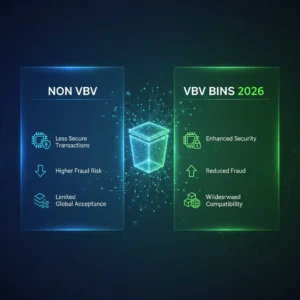
2026 Non VBV BIN is informal terminology used online for a BIN that people associate with cards that don’t consistently trigger a particular Verified by Visa authentication experience.
VBV originally referred to Verified by Visa.
Modern Visa terminology uses Visa Secure, while the broader technology is generally referred to as 3D Secure (3DS).
The important point is that “non VBV” isn’t an official Visa or Mastercard BIN classification.
A payment can be authenticated through several different mechanisms, and whether authentication occurs can depend on the specific transaction.
What Is a BIN Real Meaning?
BIN stands for Bank Identification Number.
The BIN identifies the issuer or card range associated with a payment card.
Modern payment infrastructure has moved toward eight-digit BINs, although six-digit BINs remain important in existing payment-card infrastructure.
BIN attributes can help identify information such as:
- Card network
- Issuing institution
- Country
- Card type
- Funding type
- Product information
- Account-range information
Payment companies use this information for legitimate purposes including payment routing, fraud detection, authorization analysis, and transaction optimization.
Are Non VBV BINs an Official Category?
This is probably the most important thing to understand when researching non VBV BIN lists.
Visa and Mastercard don’t publish an official category called:
Third-party websites may label BINs as “VBV,” “non VBV,” “3DS,” or “non 3DS,” but those labels don’t necessarily represent an official network classification.
A third-party database can also become outdated.
Non VBV BINs 2026
Searches for non VBV BINs 2026 are particularly interesting because payment authentication has changed considerably over the years.
The old VBV/non-VBV distinction doesn’t capture the full modern payment environment.
Today, online payments can involve:
- 3D Secure
- Risk-based authentication
- Strong Customer Authentication
- Device authentication
- Biometrics
- Issuer verification
- Fraud scoring
- Merchant risk controls
This means a card that doesn’t receive a visible OTP challenge isn’t necessarily “non VBV.”
It may simply have gone through a different authentication flow.
Non VBV BINs USA
Searches for USA non VBV BINs generally refer to BINs associated with cards issued in the United States that users believe have particular authentication characteristics.
But the country alone cannot determine whether a payment will require authentication.
Two cards issued in the United States can have different:
- Issuers
- Card products
- Authentication capabilities
- Fraud controls
- Account ranges
- Transaction behavior
Therefore, a USA non VBV BIN list shouldn’t be treated as a guarantee of payment behavior.
Non VBV BINs UK
The same applies to searches for UK non VBV BINs.
A UK-issued card isn’t automatically non-VBV or non-3DS.
Authentication can depend on the issuer, merchant, transaction, payment method, regulatory requirements, and risk assessment.
UK payment authentication can also involve mechanisms beyond a traditional SMS OTP.
Non VBV BINs Canada
Canadian BINs are similarly affected by the wider payment environment.
A BIN associated with Canada can identify the issuer and card range, but it doesn’t guarantee whether a specific payment will require authentication.
This is why static country-based lists should be treated as reference information rather than guaranteed payment rules.
Non VBV BIN List: Why Static Lists Become Outdated
One of the biggest problems with online non VBV BIN lists is that BIN and payment information changes.
A list published months ago can contain:
- Outdated issuer information
- Incorrect card classifications
- Old account ranges
- Incorrect country data
- Old payment assumptions
- BINs that no longer behave as previously described
Payment providers also continuously update fraud and authentication systems.
Consequently, a list containing hundreds or thousands of BINs isn’t necessarily useful simply because it is large.
Accuracy and freshness matter more than the number of entries.
Why BINs Don’t Guarantee Payment Results
A common misconception is:
BIN → payment result
In reality, the process is considerably more complicated.
A payment decision can involve:
Card + issuer + merchant + transaction + country + risk signals + authentication requirements
The BIN is only one component.
For example, a merchant may request additional authentication because of the transaction itself, even if someone previously categorized the BIN as “non-VBV.”
What Is 3D Secure?
3D Secure is an authentication framework used to help protect online card transactions.
Visa uses the name Visa Secure, while Mastercard uses Identity Check.
Depending on the transaction, authentication may involve:
- Passwords or codes
- Banking-app approval
- Biometrics
- Device verification
- Risk-based authentication
Modern 3DS isn’t simply an SMS OTP system.
That’s why the phrase “no OTP” can sometimes create confusion.
Does No OTP Mean No 3D Secure?
No.
A transaction can potentially be authenticated without the customer seeing a traditional SMS OTP.
For example, risk-based or device-based authentication can allow a payment to proceed without a visible challenge.
Therefore:
No SMS challenge ≠ no authentication.
This distinction is important when evaluating websites claiming to have “non-VBV” or “no-OTP” payment options.
Non MSC BINs: What Does MSC Mean?
The term MSC can be used differently depending on the context.
In payment discussions, people sometimes use non-MSC BIN as shorthand for a particular merchant, card, or payment classification. Unfortunately, third-party websites don’t always use the terminology consistently.
That makes claims about “Stripe non-MSC BINs” particularly difficult to interpret without knowing exactly what the source means by MSC.
If you’re researching a BIN database, look for the actual attributes being reported instead of relying on labels such as “non-MSC.”
Useful attributes can include:
- BIN/IIN
- Issuer
- Country
- Network
- Funding type
- Card type
- Product
- Account range
- Last updated date
Non MSC BINs for Stripe
Stripe payment processing doesn’t operate from a simple public list of “non-MSC BINs.”
Payment outcomes can depend on the card, merchant, transaction, authentication requirements, fraud controls, and applicable regulations.
Stripe supports 3D Secure authentication and provides merchants with tools for managing payment authentication and fraud prevention.
That means a third-party list claiming that particular BINs are guaranteed to avoid authentication should be treated skeptically.
Why Stripe Payment Results Can Differ
The same card can potentially produce different payment experiences at different merchants.
Factors can include:
- Merchant configuration
- Transaction amount
- Customer location
- Merchant location
- Card issuer
- Risk signals
- Previous activity
- Authentication requirements
- Fraud rules
Therefore, a BIN should not be treated as a universal prediction of what Stripe will do with a payment.
What Are Cardable Sites?
“Cardable sites list” is informal slang commonly associated with websites that people claim accept transactions made using compromised or unauthorized card information.
It isn’t an official payment-industry classification.
A website described online as “cardable” may simply be:
- Misclassified
- Outdated
- A normal merchant
- A website with changed payment processing
For legitimate users, “cardable” shouldn’t be treated as a quality or reliability indicator.
Why Cardable Lists Are Unreliable
Suppose a website publishes a list of supposedly cardable merchants.
A payment provider can change its fraud controls without warning.
The merchant might also change:
- Payment processors
- Checkout technology
- Authentication settings
- Transaction limits
- Supported countries
- Fraud rules
As a result, an old list can continue circulating even after its information is no longer accurate.
The Problem With “Working BIN” Claims
You may encounter pages claiming:
- “100% working BINs”
- “Fresh non-VBV BINs”
- “Guaranteed Stripe BINs”
- “Updated cardable list”
- “No-OTP BINs”
These claims should be approached carefully unless from nonvbvshop.net one trusted
Can a BIN Reveal a Cardholder’s Balance?
No.
A BIN can provide information about an issuer and card range.
It does not reveal an individual cardholder’s:
- Current balance
- Available credit
- Account password
- Transactions
- Personal banking information
Claims that a BIN database can reliably identify an individual’s current balance should be treated as misinformation or a scam.
What Makes a Good BIN Database?
For legitimate research and payment operations, a useful BIN database should provide transparent information about its source and update frequency.
Look for:
Current data
The database should indicate when information was last updated.
Clear attributes
A good database should explain what each field means.
Eight-digit BIN support
Modern BIN infrastructure increasingly uses eight-digit identifiers.
Account-range information
Where applicable, account-range information can provide more detail than relying exclusively on a six-digit prefix.
Reliable sourcing
Data should come from a reputable payment-industry source rather than an anonymous list.
Why 2026 BIN Data Is Different
The payment industry continues to evolve.
Eight-digit BINs, updated account ranges, modern 3DS authentication, stronger fraud detection, and new payment methods all make old terminology less useful.
A page published years ago may still rank for “non-VBV BINs,” but its underlying assumptions may no longer describe modern payment processing accurately.
That’s why a good 2026 guide should explain the technology behind the terminology, not simply reproduce an old list.
Non-VBV BINs vs 3D Secure
These terms are related but aren’t opposites.
| Term | What it refers to |
|---|---|
| BIN | Identifies an issuer/card range |
| VBV | Older Verified by Visa terminology |
| Visa Secure | Modern Visa authentication branding |
| 3DS | Online card authentication framework |
| OTP | One-time password |
| Non-VBV | Informal online terminology |
| Non-MSC | Informal/ambiguous third-party terminology |
The biggest mistake is assuming that these terms describe permanent properties of an individual card.
They don’t necessarily do so.
Are Non VBV BIN Lists Safe to Use?
It depends on what you’re using them for.
BIN information has many legitimate applications, including payment analytics, fraud prevention, issuer identification, and payment routing.
However, using stolen payment credentials or attempting to bypass authentication is not legitimate payment processing.
A BIN database should therefore be treated as card metadata, not as a method for defeating payment security.
Frequently Asked Questions
What are non-VBV BINs?
Non-VBV BIN is informal terminology used online for BINs believed to be associated with cards that don’t consistently trigger a particular Verified by Visa or 3D Secure authentication experience.
Are non-VBV BINs an official category?
No. “Non-VBV” isn’t an official Visa or Mastercard BIN classification.
Are there USA non-VBV BINs?
Third-party databases may categorize BINs by country, including the United States, but a USA BIN doesn’t guarantee a particular authentication outcome.
Are there UK non-VBV BINs?
UK BINs can be identified through issuer and country attributes, but the BIN itself doesn’t guarantee whether a transaction will require authentication.
What about Canada non-VBV BINs?
The same principle applies to Canadian BINs. Country and issuer information don’t guarantee a specific payment result.
Are non-VBV BIN lists accurate?
Some BIN databases contain legitimate issuer information, but static “non-VBV” classifications can become outdated quickly.
What are Stripe non-MSC BINs?
The phrase is primarily used in third-party discussions rather than as a universal Stripe classification. The exact meaning of “MSC” should be verified from the source using the term.
Does a non-VBV BIN guarantee no OTP?
No. Authentication depends on the payment, issuer, merchant, risk assessment, and other factors.
Does no OTP mean no 3D Secure?
No. Modern authentication can occur without a traditional SMS OTP.
Can BINs reveal card balances?
No. BIN information identifies card and issuer attributes; it doesn’t reveal an individual’s current balance.
Final Thoughts
Non-VBV BINs 2026 remains a popular search topic because the terminology sits at the intersection of BIN databases, online payments, Stripe, 3D Secure, and card verification.
A BIN can tell you useful information about a card’s issuer and product. It cannot guarantee that a transaction will avoid authentication or be accepted by a particular merchant.
The same applies to searches for USA non-VBV BINs, UK non-VBV BINs, Canada non-VBV BINs, Stripe non-MSC BINs, and cardable sites.
The most useful approach is to understand how modern payment authentication works rather than treating an old “working BIN list” as a permanent rule.
For legitimate payment research, focus on accurate BIN attributes, current account-range information, issuer data, and the modern 3D Secure ecosystem.
And when you encounter a website promising guaranteed “non-VBV,” “no-OTP,” or “working” payment results, remember that a marketing label on a webpage isn’t the same thing as an official payment-network classification.