
Searches for terms such as Bitcoin non VBV BINs, non VBV BIN list 2026, VBV BINs, and MSC BINs continue to appear online, particularly in discussions surrounding cryptocurrency payments, online card security, and 3D Secure.
But there is considerable confusion surrounding what these terms actually mean.
A BIN does not automatically tell you whether every transaction made with a particular card will require additional authentication. Modern payment systems have moved toward dynamic, risk-based authentication, making many traditional “VBV” and “non VBV” lists unreliable.

This guide explains what Bitcoin non VBV BINs are supposed to mean, the difference between VBV and MSC terminology, how BIN numbers actually work, and whether the BIN lists circulating online remain reliable in 2026.
What Is a BIN?
A BIN, or Bank Identification Number, refers to the opening digits of a payment card number.
The industry also uses the term Issuer Identification Number (IIN).
These numbers help payment networks identify information associated with a card, such as its issuing institution, payment network, card program, and other routing information.
Historically, people commonly referred to the first six digits as the BIN.
However, the payments industry has expanded toward eight-digit BINs, meaning older databases built primarily around six-digit identifiers can contain incomplete or outdated information.
A BIN is therefore primarily an identification and routing mechanism.
It should not be treated as a universal indicator of how a particular online transaction will be authenticated.
What Does Non VBV BIN Mean?
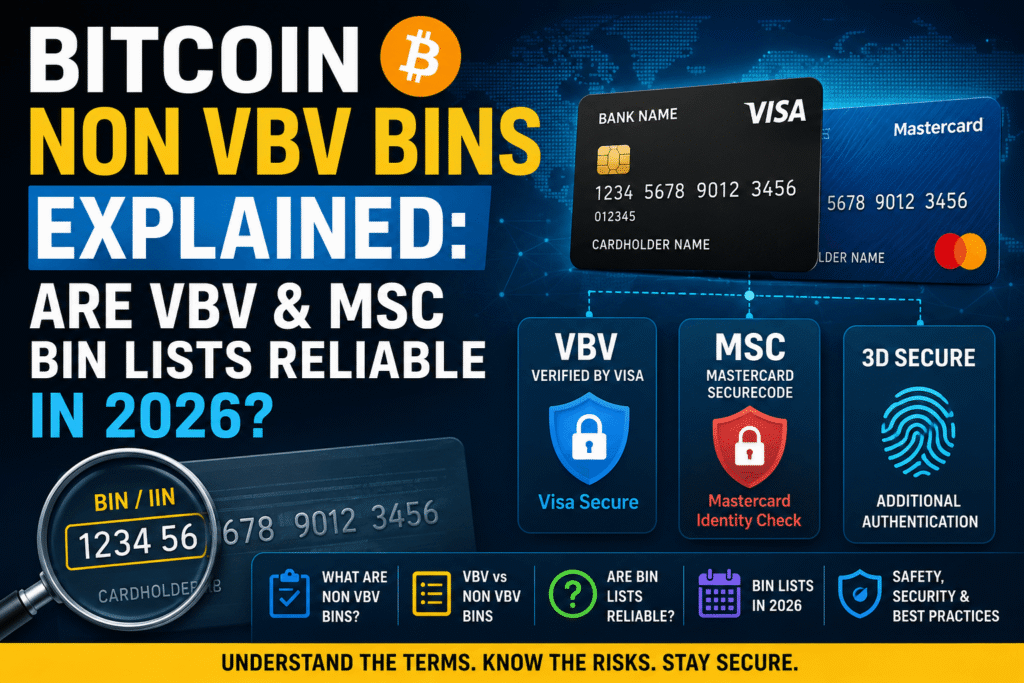
VBV originally referred to Verified by Visa, an authentication system designed to add another security layer to online Visa transactions.
The technology belongs to the broader family of authentication systems known as 3-D Secure (3DS).
The phrase non VBV BIN became internet shorthand for a BIN supposedly associated with cards that did not use Verified by Visa authentication.
This terminology remains common in search engines, forums, old payment discussions, and archived BIN databases.
However, the phrase can be misleading today.
Modern authentication doesn’t necessarily operate as a permanent characteristic attached to a BIN.
Whether additional verification occurs can depend on the merchant, issuer, payment processor, transaction characteristics, applicable regulations and the issuer’s risk assessment.
Consequently, labeling an entire BIN permanently “VBV” or “non VBV” oversimplifies how modern card authentication works.
What Are Bitcoin Non VBV BINs?
The phrase Bitcoin non VBV BINs generally appears in searches involving cryptocurrency purchases and card authentication.
Someone searching the phrase may be trying to determine whether cards from certain issuers encounter 3D Secure authentication when purchasing cryptocurrency.
However, there isn’t a special category of BIN officially known as a “Bitcoin non VBV BIN.”
Bitcoin does not maintain a database of non VBV cards.
Cryptocurrency exchanges and payment processors establish their own payment requirements, while card issuers and payment networks can apply additional authentication or risk controls.
A cryptocurrency purchase may also be treated differently from an ordinary online retail purchase.
Therefore, a card behaving one way on one merchant doesn’t guarantee identical behavior on a cryptocurrency platform.
VBV vs Non VBV BINs
Historically, the distinction was described fairly simply.
A VBV card supposedly participated in Verified by Visa authentication, while a non VBV card supposedly did not.
Modern payments are considerably more complicated.
With newer versions of 3D Secure, information about a transaction can be analyzed before the issuer determines whether additional interaction with the cardholder is necessary.
Some transactions can proceed through a low-friction authentication flow.
Others can trigger a challenge.
That means two transactions involving cards associated with the same BIN can potentially produce different authentication experiences.
This is one major reason static VBV BIN lists should not be interpreted as guaranteed predictions.
What Are MSC BINs?
Another phrase frequently appearing beside VBV is MSC, usually referring to older Mastercard SecureCode terminology.
Mastercard SecureCode was Mastercard’s earlier branding for its additional online cardholder authentication system.
Mastercard’s modern consumer-facing authentication technology is generally associated with Mastercard Identity Check and EMV 3-D Secure.
Nevertheless, searches such as:
MSC BIN list
non MSC BINs
VBV and MSC BINs
MSC BIN checker
continue to exist because older terminology remains deeply embedded in online discussions.
Much like “non VBV,” however, calling a BIN “MSC” or “non MSC” does not necessarily predict exactly what will happen during every future transaction.
Verified by Visa vs Visa Secure
Another source of confusion is branding.
Many websites, databases and forum posts continue using Verified by Visa because the term was widely recognized for years.
Visa’s newer branding is Visa Secure.
Visa Secure operates using modern EMV 3-D Secure technology designed to allow merchants and issuers to exchange more information about a transaction.
This additional information can help issuers assess whether the transaction appears legitimate.
Therefore, someone searching for a Verified by Visa BIN in 2026 may actually be encountering a modern Visa Secure implementation rather than the older authentication experience they remember.
Mastercard SecureCode vs Mastercard Identity Check
A similar transition occurred with Mastercard.
Older online discussions frequently mention Mastercard SecureCode, while Mastercard now promotes Mastercard Identity Check for online payment authentication.
This distinction matters when researching BIN information.
A webpage claiming that a particular BIN doesn’t support “SecureCode” may have been created years ago.
That does not establish that cards currently issued under that BIN won’t participate in newer authentication technology.
Payment security evolves while old terminology remains indexed online.
What Is 3D Secure?
3-D Secure, commonly abbreviated 3DS, is an authentication framework designed to help reduce fraud in card-not-present transactions.
Modern versions can analyze numerous pieces of transaction information.
Depending on the transaction and issuer’s assessment, authentication can be relatively seamless or require additional verification from the cardholder.
This is sometimes described as the difference between a frictionless flow and a challenge flow.
A frictionless transaction does not mean the card is necessarily “non VBV.”
Authentication may have occurred without requiring the customer to manually enter additional information.
This distinction is extremely important when interpreting claims about non VBV cards.
Why Some Transactions Don’t Show a 3D Secure Challenge
People sometimes assume that if an online transaction completes without an OTP or authentication screen, the card must be non VBV.
That conclusion isn’t necessarily correct.
Modern 3D Secure was specifically designed to reduce unnecessary friction.
A transaction can potentially be authenticated without displaying a traditional challenge to the cardholder.
Other transactions might require additional confirmation.
The result depends on the particular transaction and the systems involved.
Therefore:
No visible challenge ≠ proof of a non VBV card.
This is one of the biggest misconceptions surrounding non VBV BIN discussions.
Are Non VBV BIN Lists Reliable in 2026?
Static non VBV BIN lists are not a reliable guarantee of transaction authentication behavior.
There are several reasons.
First, card programs change.
Banks can introduce new security systems, migrate portfolios, replace processors or change authentication policies.
Second, BIN assignments can change.
The transition from six-digit to eight-digit BINs has also made simplistic BIN databases less useful for identifying individual card programs.
Third, authentication decisions can be dynamic.
A transaction that proceeds without a visible challenge today could receive a challenge under different circumstances.
Finally, merchants themselves can have different fraud controls and payment configurations.
A card’s experience at Merchant A therefore doesn’t necessarily predict its experience at Merchant B.
Why Old Non VBV BIN Lists Become Outdated
Search engines contain BIN lists published many years ago.
Some have simply been copied from one website to another.
This creates an interesting problem.
A list might originally have contained information that reflected a particular issuer’s configuration at the time it was created.
Years later, the same information may continue circulating despite the issuer changing its systems.
For example, changes can occur involving:
- issuing banks;
- card processors;
- card products;
- BIN ranges;
- 3DS enrollment;
- fraud controls;
- authentication policies; and
- payment network requirements.
Copying an old list and adding “2026” to its title doesn’t make its underlying information current.
Are BIN Checkers Reliable?
BIN lookup tools can still have legitimate purposes.
They can help identify general information associated with an issuer or card range.
However, problems arise when a BIN checker claims it can definitively determine whether a card will require authentication during a future purchase.
A lookup database and a real-time authorization system are fundamentally different things.
BIN databases generally provide reference information.
Actual payment authentication occurs through merchants, payment processors, networks and issuing banks.
A public database therefore cannot reliably reproduce every decision those systems will make during a real transaction.
Can a BIN Tell You Whether a Card Uses 3D Secure?
Not with absolute certainty for every transaction.
A BIN can provide useful information about the card program, but authentication behavior involves more than the card’s opening digits.
Modern payment security is transaction-specific.
This is why statements such as:
“This BIN never requires 3D Secure.”
should be treated skeptically.
Even if someone observed that behavior previously, it doesn’t establish a permanent rule.
Are Bitcoin BIN Lists Different?
There is no universal Bitcoin BIN list maintained by Bitcoin itself.
Lists carrying names such as “Bitcoin BINs,” “crypto BINs,” or “Bitcoin non VBV BINs” are typically unofficial databases or user-created collections.
Cryptocurrency platforms may also have stricter payment controls because crypto transactions can present different fraud and chargeback risks from conventional retail purchases.
A card issuer may permit one type of online purchase while declining or applying additional verification to another.
The merchant category and transaction context matter.
This makes simplistic Bitcoin BIN lists particularly unreliable as predictors.
Non VBV BINs and Risk-Based Authentication
Risk-based authentication is perhaps the biggest reason the traditional concept of a permanent “non VBV BIN” has become less meaningful.
Modern payment systems can evaluate transaction information and decide how much authentication is appropriate.
Low-risk transactions may require very little visible interaction.
Transactions presenting additional risk may receive stronger authentication requirements.
The important distinction is that the decision can occur per transaction, rather than being determined exclusively by the BIN.
Is Non VBV the Same as No Security?
No.
This is another common misunderstanding.
Even when a transaction does not display a 3D Secure challenge, numerous other security mechanisms can still exist.
Issuers, merchants, and processors can use fraud detection, behavioral analysis, transaction monitoring, velocity controls, device information and authorization rules.
3D Secure represents one component of a much larger payment-security ecosystem.
Therefore, “no OTP appeared” should never be interpreted as “there was no security.”
Do Non VBV Cards Still Exist in 2026?
The terminology still exists online, but its traditional interpretation has become increasingly outdated.
There may be circumstances where 3D Secure isn’t used or where a transaction doesn’t produce a visible challenge.
But describing a modern card as permanently “non VBV” can create the wrong impression.
A more accurate question is:
Will this particular transaction require additional cardholder authentication?
That answer can depend on multiple systems making decisions in real time.
Why People Still Search for Non VBV BINs
Search terminology often survives long after technology changes.
non VBV BINs
VBV BIN list
Bitcoin non VBV BINs
MSC BIN list
non MSC BINs
Verified by Visa BIN checker
even though the payment industry increasingly uses terminology such as Visa Secure, Mastercard Identity Check and EMV 3-D Secure.
This is similar to people using an old product name even after the technology behind it has evolved.
Understanding the historical terminology is useful, but relying on old assumptions can lead to inaccurate conclusions.
Frequently Asked Questions
What does non VBV BIN mean?
Historically, it referred to a BIN believed to be associated with cards that didn’t use Verified by Visa authentication. Modern risk-based authentication makes that definition much less reliable.
What does VBV mean?
VBV stands for Verified by Visa, the older name commonly associated with Visa’s online authentication system. Visa now uses Visa Secure branding.
What does MSC mean?
In BIN discussions, MSC commonly refers to Mastercard SecureCode, an older Mastercard authentication brand. Mastercard Identity Check is the newer terminology.
What is a non MSC BIN?
The phrase historically described a Mastercard BIN believed not to participate in Mastercard SecureCode. It should not be considered a guarantee that modern Mastercard authentication won’t occur.
What are Bitcoin non VBV BINs?
It is an unofficial internet/search term generally referring to BINs claimed to work for cryptocurrency purchases without a traditional VBV challenge. Bitcoin itself doesn’t designate BINs as VBV or non VBV.
Are non VBV BIN lists accurate?
They can be outdated or misleading, particularly when they attempt to predict future authentication behavior. Issuer policies, BIN ranges and authentication systems can change.
Are VBV BIN checkers reliable?
BIN lookup services can provide issuer-level reference information, but they cannot guarantee exactly how a future transaction will be authenticated.
Can the same BIN require verification sometimes but not others?
Potentially, yes. Modern authentication can consider the individual transaction rather than relying exclusively on the BIN.
Does no OTP mean a card is non VBV?
No. Modern 3D Secure can sometimes operate without showing the cardholder a traditional OTP challenge.
Is Visa Secure the same as Verified by Visa?
Visa Secure is the modern evolution/branding associated with Visa’s online payment authentication technology.
Is Mastercard SecureCode still used?
The SecureCode name remains common in older material and search queries, but Mastercard’s newer authentication branding is Mastercard Identity Check.
Are six-digit BIN lists still useful?
They can provide general historical or issuer-level information, but the industry’s move toward eight-digit BINs means older six-digit databases may lack the precision needed for newer card ranges.
Is there an official Bitcoin non VBV BIN list?
No. Bitcoin does not publish or maintain an official list of payment card BINs classified as VBV or non VBV.
Final Thoughts
Bitcoin non VBV BINs, VBV BIN lists and MSC BIN lists remain popular search terms in 2026, but the technology behind card authentication has changed significantly.
Verified by Visa and Mastercard SecureCode terminology originated in an earlier generation of online payment authentication. Today’s ecosystem increasingly relies on Visa Secure, Mastercard Identity Check and modern EMV 3-D Secure technology.
Most importantly, authentication is no longer something that can always be predicted simply by looking at a card’s BIN.
Issuers and payment systems can evaluate individual transactions and determine whether additional authentication is appropriate.
That makes static lists claiming certain BINs are permanently “VBV,” “non VBV,” “MSC,” or “non MSC” increasingly unreliable.
BIN databases can still be useful for understanding card ranges and issuers, but they should not be confused with real-time authentication systems.
In 2026, the better way to understand these terms is not to ask which BIN supposedly “bypasses” authentication, but to understand how BIN identification, Visa Secure, Mastercard Identity Check and risk-based 3D Secure authentication work together in modern online payments.