
The term non VBV cards 2026 continues to appear in searches related to online payments, card verification, BIN databases, and payment gateways. You may also see related phrases such as non VBV card number, non VBV Mastercard, non VBV credit card, auto non VBV BINs, free non VBV bin checkers, and non VBV gateways.
But what do these terms actually mean in 2026?
In most cases, non VBV bins refers to a payment card transaction that does not involve Verified by Visa (VBV), the older branding associated with Visa’s 3-D Secure authentication system. Modern payment authentication has evolved significantly, so treating “non VBV” as a special type of card can be misleading.

This guide explains the terminology, how modern card authentication works, and what to know about websites or services advertising non-VBV cards, BINs, checkers, or gateways.
What Does Non VBV Mean?
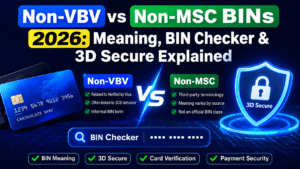
Non VBV generally means that a particular card transaction does not go through a Verified by Visa authentication step.
VBV was associated with Visa’s earlier implementation of 3-D Secure. The technology was designed to add an additional layer of authentication when a customer paid online.
Today, Visa uses the Visa Secure branding for its 3-D Secure services, while Mastercard uses Identity Check. Authentication can involve different methods, including risk-based authentication, biometric verification, passwords, or one-time codes.
Therefore, a card shouldn’t automatically be described as permanently “non-VBV.” Whether authentication is requested can depend on the card issuer, merchant, payment processor, transaction, location, and risk assessment.
Non VBV Card Number: What Does It Mean?
A non VBV card number is not a special category of card number issued by Visa or Mastercard.
The phrase is commonly used online to describe a card that can apparently be used for a transaction without an additional 3-D Secure authentication challenge.
However, the presence or absence of an authentication challenge isn’t determined simply by looking at a card number.
A legitimate payment transaction can involve multiple systems behind the scenes, including:
- The card issuer
- The card network
- The merchant
- The payment processor
- Fraud-detection systems
- 3-D Secure authentication services
Consequently, a BIN or card number alone cannot reliably tell someone whether a future transaction will require authentication.
What Is a Non VBV Mastercard?
The phrase non VBV Mastercard is often used in online searches to describe Mastercard cards that supposedly don’t require additional authentication.
Mastercard does not generally issue a special product officially called a “non VBV Mastercard.”
Mastercard’s modern authentication framework is associated with 3-D Secure and Mastercard Identity Check. Whether a transaction is challenged depends on the circumstances surrounding that transaction.
A legitimate Mastercard may therefore complete some online purchases without an obvious authentication prompt while requiring additional verification for another transaction.
Non VBV Credit Cards Explained
A non VBV credit card usually refers to a credit card involved in a transaction where 3-D Secure authentication isn’t requested.
That doesn’t necessarily mean the card is less secure.
Modern payment systems can use risk-based decision-making. A transaction may be approved without requiring the customer to enter a password or one-time code because the issuer and payment ecosystem determine that the transaction presents relatively low risk.
Other transactions may trigger additional authentication.
This means “non-VBV” should not be interpreted as “unsecured card” or “card that always bypasses authentication.”
What Are Auto Non VBV BINs?
A BIN, or Bank Identification Number, refers to the initial portion of a payment card number used to identify information associated with the issuing institution and card program.
Modern terminology increasingly uses IIN (Issuer Identification Number), although “BIN” remains extremely common.
Searches for auto non VBV BINs or auto VBV BINs often refer to databases or automated services that attempt to categorize card ranges according to characteristics such as:
- Issuing country
- Card network
- Card type
- Issuer
- Debit or credit classification
- Commercial or consumer classification
The important point is that a BIN database cannot reliably predict whether every future transaction will require 3-D Secure authentication.
Authentication decisions can occur dynamically.
What Is a Non VBV Checker?
A non VBV checker is a term used online for a service that claims to determine whether a card, BIN, merchant, or payment flow involves 3-D Secure authentication.
The reliability of such services varies considerably.
A legitimate BIN-information service may provide basic information about a card range. However, a service claiming it can guarantee whether a particular card will pass a future transaction without authentication should be treated cautiously.
A transaction’s authentication requirements can change based on factors such as:
- Merchant configuration
- Issuer decisions
- Transaction amount
- Country
- Device information
- Risk signals
- Previous transaction history
- Payment processor
- 3-D Secure configuration
There is therefore no universal checker that can guarantee how a legitimate card transaction will behave in every situation.
Non VBV Gateways: What Does the Term Mean?
The phrase non VBV gateway is commonly used to describe a payment gateway or checkout environment where 3-D Secure authentication isn’t required for a particular transaction.
However, payment gateways don’t simply operate as permanent “VBV” or “non VBV” systems.
Merchants and processors can use different authentication configurations, and the payment network or issuer can influence whether authentication is required.
A checkout may therefore appear to work without an authentication prompt for one transaction and require additional verification for another.
Businesses choosing a payment gateway should focus on legitimate factors such as:
- Supported payment methods
- Security features
- Fraud prevention
- 3-D Secure support
- Chargeback management
- Geographic availability
- Fees
- Integration options
- Compliance requirements
Non VBV vs 3-D Secure
The easiest way to understand the terminology is to distinguish between a card and an authentication process.
Non VBV is an informal term describing the absence of a particular authentication step.
3-D Secure is a security protocol used to authenticate online card transactions.
A transaction can therefore be completed without a visible authentication challenge while still being evaluated by sophisticated fraud-detection systems.
Modern 3-D Secure implementations can also support frictionless authentication, where the customer doesn’t necessarily see an additional verification screen.
This is one reason older explanations of “VBV versus non-VBV” can be confusing in 2026.
Are Non VBV BIN Lists Reliable?
BIN lists can be useful for general card-information purposes, but they shouldn’t be treated as a guarantee of transaction behavior.
A BIN database may contain information such as the issuer, country, card network, and card type. However, authentication requirements are not necessarily permanent properties of an entire BIN range.
Information can also become outdated when banks change card programs, processors change configurations, or payment networks update their systems.
If you’re using BIN information for legitimate payment analysis, verify important information through reliable sources rather than relying on an anonymous list promising guaranteed results.
Why Non VBV Searches Can Be Misleading
The terminology has become popular because older payment systems were often described using simple categories such as VBV and non-VBV.
Modern payment authentication is more complicated.
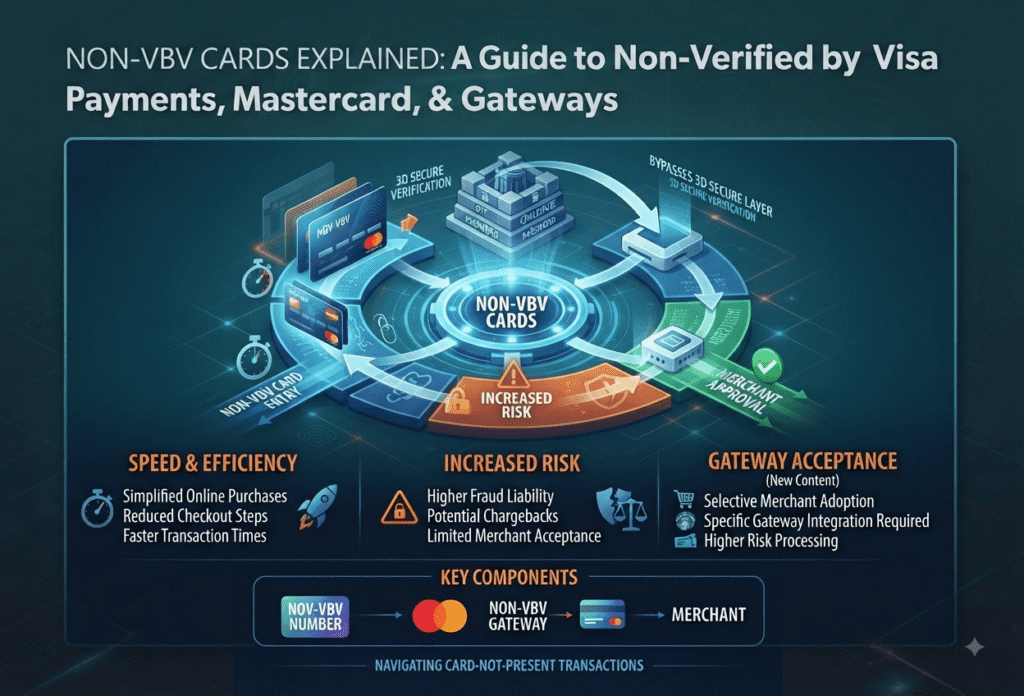
A transaction can involve:
- Card details being submitted to a merchant.
- The payment processor sending the authorization request.
- Fraud and risk systems evaluating the transaction.
- 3-D Secure authentication being requested when appropriate.
- The issuing bank approving or declining the transaction.
- The merchant receiving the final payment result.
Because multiple systems participate in the process, there is no universal “non-VBV card” status that guarantees a particular outcome.
Are Non VBV Cards Still Relevant in 2026?
The phrase is still widely searched, but the underlying technology has moved beyond the terminology.
Visa Secure and Mastercard Identity Check are part of the modern 3-D Secure ecosystem, while risk-based authentication can allow some transactions to proceed without an obvious challenge.
For consumers, the important distinction is not whether a card is marketed as “non-VBV.” Instead, it’s whether the transaction is legitimate, authorized, and protected by appropriate security controls.
For merchants, properly configured authentication and fraud-prevention systems are more important than finding a supposedly “non-VBV” payment environment.
Security Risks to Watch For
Search results for non VBV cards sometimes lead to websites advertising card numbers, automated checkers, payment gateways, or guaranteed transaction results.
These offers can carry serious risks.
Never purchase or use someone else’s payment-card information. Never provide your own card details to an unknown checker simply because it claims to verify card status.
Be especially cautious of services promising:
- Guaranteed approvals
- Guaranteed successful transactions
- “Live” card information
- Stolen card databases
- Card verification services for unauthorized cards
- Methods for bypassing bank authentication
Besides the security risk, using unauthorized payment information can result in financial loss, account restrictions, chargebacks, and criminal consequences.
Final Thoughts
Non VBV cards remain a popular search term in 2026, but the phrase doesn’t describe a special class of Visa or Mastercard cards.
Searches for non VBV card numbers, non VBV Mastercard, non VBV credit cards, auto non VBV BINs, non VBV checkers, and non VBV gateways largely reflect interest in whether an online card transaction will require additional authentication.
Modern payment security is much more dynamic than the old VBV terminology suggests. Authentication can depend on the issuer, merchant, processor, transaction, risk assessment, and 3-D Secure configuration.
For legitimate users and businesses, the safest approach is to understand how modern authentication works rather than relying on claims that a particular BIN, card, checker, or gateway can guarantee a specific transaction outcome.